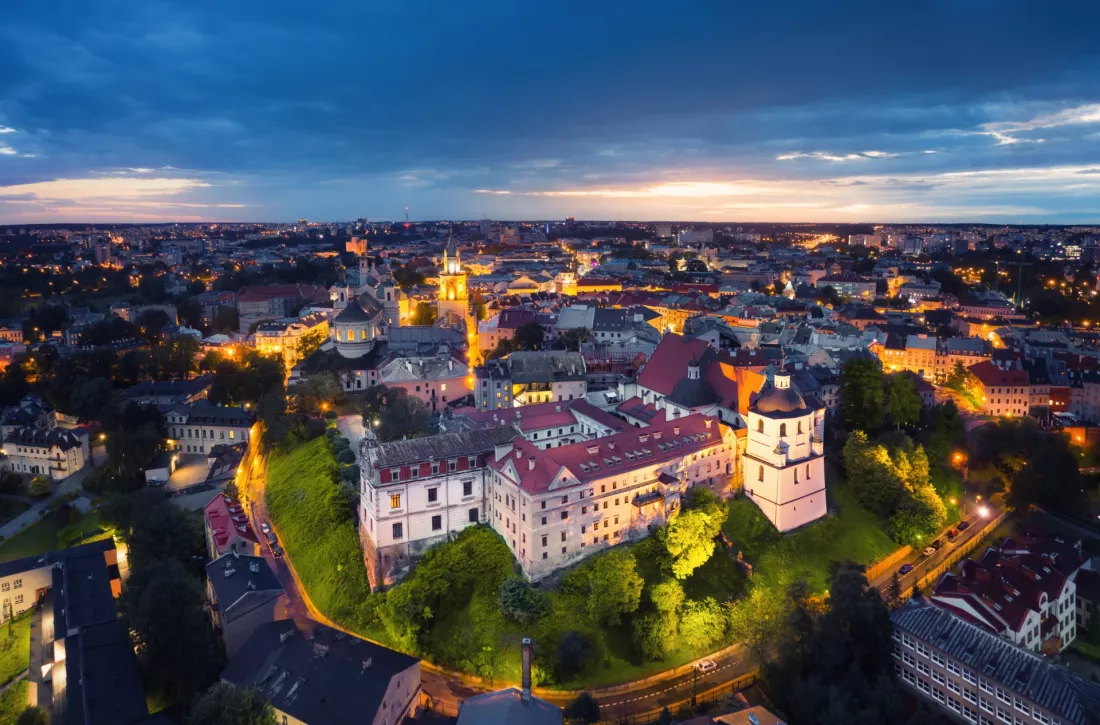


Lublin, Poland

International Relations

Stosunki międzynarodowe

Master's
Table of contents
conceptual-business-handshake-with-dashboard-financial-data-analysis

⇑International Relations at UMCS

Language: PolishStudies in Polish
Subject area: economy and administration
Kind of studies: full-time studies
  • Description:

  • pl

⇑Why study International Relations (Master's) at UMCS?

dlaczego-warto-studiowac-na-UMCS
Why study it:

International Relations at Maria Curie-Skłodowska University in Lublin (UMCS) is a two-year, full-time Master's programme with a general academic profile, taught in English at the Faculty of Political Science and Journalism and open to both Polish and international students. It is for graduates who want to analyse and explain a fast-changing world – relations between states, international organisations and non-state actors, and the processes shaping the international environment.

Programme: a multi-faceted, multi-level view of change

The programme treats international relations as cross-border activities and processes that are political, economic, social, cultural, military and ecological at once. They are studied at several levels – global, regional and national – with a particular focus on the phenomenon of change. Alongside the core curriculum you choose from a range of optional subjects, and classes are also taught by foreign lecturers and visiting professors from around the world.

Specialisation: three specialisations

You can choose one of the specialisations:

  • Economic Diplomacy
  • International Institutions
  • International Place Branding

Placements: internships and study trips

The programme offers domestic and foreign apprenticeships and internships, as well as study trips to state institutions dealing with foreign policy and to international organisations. You also meet people from politics, diplomacy, the media and culture.

Outside class you can join scientific clubs and Oxford-style debates, take trainings and courses run by the UMCS Competence Development Office, and develop your own ideas in the Academic Incubator of Entrepreneurship.

Exchanges: study at a partner university

Through the Erasmus programme you can study at one of the partner universities abroad, adding international experience to a degree that is already taught entirely in English.

As of the 2026/27 admissions, based on the programme pages at irk.umcs.pl.

⇑Test: Is International Relations the right fit for you?

International Relations test en

Answer all the questions and find out if International Relations is the right field of study for you!

1. Are you prepared to study, write papers, and conduct debates exclusively in English?

2. Are you fascinated by the in-depth analysis of complex international conflicts and threats to global security?

3. Are you keen to study how the domestic politics of major powers (e.g., USA, China) influence their strategy on the international stage?

4. How do you view the requirement of writing a Master's thesis based on independent research and source analysis?

5. Are you interested in the interplay between the global economy and international politics (e.g., sanctions, trade wars)?

6. Are you comfortable with an interdisciplinary approach that combines knowledge from political science, law, history, and sociology?

7. Are you eager to understand the role of international law and organizations (like the UN or EU) in shaping the global order?

8. Where do you see your professional future after completing this degree?

9. Are you prepared for a critical analysis of international relations theories and their application to current events?

10. What is your main motivation for undertaking a two-year Master's degree program in this field?

⇑Definitions and quotes

International
International mostly means something (a company, language, or organization) involving more than a single country. The term international as a word means involvement of, interaction between or encompassing more than one nation, or generally beyond national boundaries. For example, international law, which is applied by more than one country and usually everywhere on Earth, and international language which is a language spoken by residents of more than one country.
International Relations
International Relations (IR) or International Affairs (IA) - commonly also referred to as International Studies (IS) or Global Studies (GS) - is the study of interconnectedness of politics, economics and law on a global level. Depending on the academic institution, it is either a field of political science, an interdisciplinary academic field similar to global studies, or an entirely independent academic discipline in which students take a variety of internationally focused courses in social science and humanities disciplines. In all cases, the field studies relationships between political entities (polities) such as sovereign states, inter-governmental organizations (IGOs), international non-governmental organizations (INGOs), other non-governmental organizations (NGOs), and multinational corporations (MNCs), and the wider world-systems produced by this interaction. International relations is an academic and a public policy field, and so can be positive and normative, because it analyses and formulates the foreign policy of a given state.
International Relations
States have two kinds of power: latent power and military power.
John Mearsheimer, The Tragedy of Great Power Politics (2001).
International Relations
In brief, for the United States, Eurasian geostrategy involves the purposeful management of geostrategically dynamic states and the careful handling of geopolitically catalytic states, in keeping with the twin interests of America in the short-term: preservation of its unique global power and in the long-run transformation of it into increasingly institutionalized global cooperation. To put it in a terminology that hearkens back to the more brutal age of ancient empires, the three grand imperatives of imperial geostrategy are to prevent collusion and maintain security dependence among the vassals, to keep tributaries pliant and protected, and to keep the barbarians from coming together.
Zbigniew Brzezinski,The Grand Chessboard (1997).
International Relations
Political realism believes that politics, like society in general, is governed by objective laws that have their roots in human nature.In order to improve society it is first necessary to understand the laws by which society lives. The operation of these laws being impervious to our preferences, men will challenge them only at the risk of failure. V`Realism, believing as it does in the objectivity of the laws of politics, must also believe in the possibility of developing a rational theory that reflects, however imperfectly and one-sidedly, these objective laws. It believes also, then, in the possibility of distinguishing in politics between truth and opinion — between what is true objectively and rationally, supported by evidence and illuminated by reason, and what is only a subjective judgment, divorced from the facts as they are and informed by prejudice and wishful thinking.
Hans Morgenthau, Politics Among Nations (1948).

Contact:

Pl. Marii Curie-Sklodowskiej 5
20-031 Lublin
Department of Education
International Students Office
phone: (+48) 81 537 29 26
facebook International Student Office


StudentNews Group Websites for students and future students — in Poland since 2007, across Europe since 2014. Over 50 websites and millions of users a year (Google Analytics). Studies in Europe Universities in Europe Bachelor’s Master’s Doctorate MBA Study guide Work abroad Travel For partners Advertising and cooperation Reach (online report) Contact advertising@studentnews.eu © 2003–2026 Grupa StudentNews.pl sp. z o.o., Modlnica, Poland
Privacy Policy