Cracow, Poland

Special Education – Education and Rehabilitation of People with Intellectual Disabilities (for Teachers Without Qualifications in Special Education)

Pedagogika specjalna: edukacja i rehabilitacja osób z niepełnosprawnością intelektualną – studia kwalifikacyjne (dla nauczycieli nieposiadających kwalifikacji z zakresu pedagogiki specjalnej

Table of contents
Postgraduate diplomas

Special Education – Education and Rehabilitation of People with Intellectual Disabilities (for Teachers Without Qualifications in Special Education)

⇑Special Education – Education and Rehabilitation of People with Intellectual Disabilities (for Teachers Without Qualifications in Special Education) at WSB Kraków

Language: Polish Studies in Polish
Subject area: teacher training and education science
University website: wsb.edu.pl/krakow

⇑Test: sprawdź czy Pedagogika specjalna: edukacja i rehabilitacja osób z niepełnosprawnością intelektualną – studia kwalifikacyjne (dla nauczycieli nieposiadających kwalifikacji z zakresu pedagogiki specjalnej to studia dla Ciebie

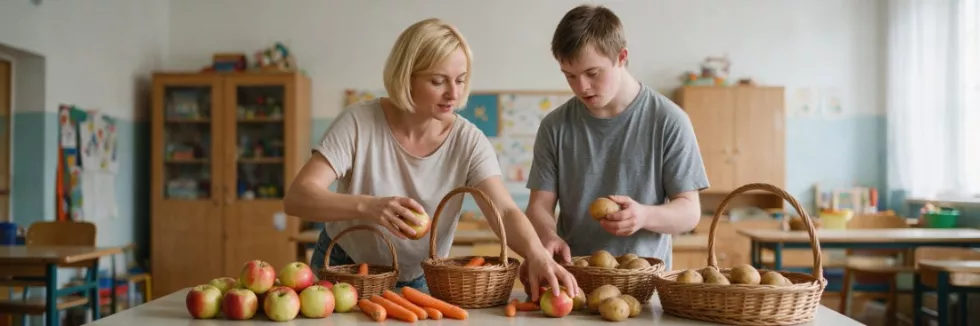
Pedagogika-specjalna-edukacja-i-rehabilitacja-osob-z-niepelnosprawnoscia-intelektualna-stu-test-Nauczycielka-uczy-ucznia-praktycznych-umiejetnosci

10 pytań · dwie minuty

1. Jesteś nauczycielem przedmiotu i od nowego roku szkolnego masz uczyć w szkole specjalnej uczniów z niepełnosprawnością intelektualną. Jak się przygotowujesz?

2. Tłumaczysz na lekcji nowe pojęcie, a uczniowie wyraźnie go nie rozumieją. Co zmieniasz?

3. Czym według Ciebie różni się nauczanie w szkole ogólnodostępnej od pracy z uczniami z niepełnosprawnością intelektualną?

4. Uczeń z niepełnosprawnością intelektualną w stopniu lekkim dostaje słabą ocenę i mówi: „Ja i tak jestem głupi”. Co robisz?

5. Czy mimo doświadczenia w zawodzie nauczyciela jesteś gotów/gotowa uczyć się nowej dziedziny od podstaw?

6. W klasie masz uczniów o bardzo różnych możliwościach — od czytających płynnie po rozpoznających tylko pojedyncze litery. Jak organizujesz lekcję?

7. Jak oceniasz postępy ucznia z niepełnosprawnością intelektualną?

8. Podczas lekcji uczeń nagle wybucha złością i rzuca przyborami. Jak reagujesz?

9. Co sądzisz o uczeniu praktycznych umiejętności — robienia zakupów czy przygotowania prostego posiłku — w ramach zajęć szkolnych?

10. Co najbardziej motywuje Cię do podjęcia studiów podyplomowych „Pedagogika specjalna: edukacja i rehabilitacja osób z niepełnosprawnością intelektualną – studia kwalifikacyjne (dla nauczycieli nieposiadających kwalifikacji z zakresu pedagogiki specjalnej”?

⇑Definitions and quotes

Education
Education is the process of facilitating learning, or the acquisition of knowledge, skills, values, beliefs, and habits. Educational methods include storytelling, discussion, teaching, training, and directed research. Education frequently takes place under the guidance of educators, but learners may also educate themselves. Education can take place in formal or informal settings and any experience that has a formative effect on the way one thinks, feels, or acts may be considered educational. The methodology of teaching is called pedagogy.
Intellectual
An intellectual is a person who engages in critical thinking, research, and reflection about society and proposes solutions for its normative problems. Some gain authority as public intellectuals. Coming from the world of culture, either as a creator or as a mediator, the intellectual participates in politics either to defend a concrete proposition or to denounce an injustice, usually by rejecting, producing or extending an ideology, and by defending a system of values.
People
A people is a plurality of persons considered as a whole, as is the case with an ethnic group or nation. Collectively, for example, the contemporary Frisians and Danes are two related Germanic peoples, while various Middle Eastern ethnic groups are often linguistically categorized as Semitic peoples.
Special Education
Special education (also known as special needs education, aided education, exceptional education or Special Ed) is the practice of educating students with an IEP or Section 504 in a way that addresses their individual differences and needs. Ideally, this process involves the individually planned and systematically monitored arrangement of teaching procedures, adapted equipment and materials, and accessible settings. These interventions are designed to help individuals with special needs achieve a higher level of personal self-sufficiency and success in school and in their community which may not be available if the student were only given access to a typical classroom education.
Teachers
A little bench of heedless bishops here,
And there a chancellor in embryo.
William Shenstone, The School Mistress, Stanza 28.
Teachers
Men must be taught as if you taught them not,
And things unknown propos'd as things forgot.
Alexander Pope, An Essay on Criticism (1709), Part III, line 15.
Intellectual
A large section of the intelligentsia seems wholly devoid of intelligence.
G. K. Chesterton, The Autobiography of G.K. Chesterton.
StudentNews Group Websites for students and future students — in Poland since 2007, across Europe since 2014. Over 50 websites and millions of users a year (Google Analytics). Studies in Europe Universities in Europe Bachelor’s Master’s Doctorate MBA Study guide Work abroad Travel For partners Advertising and cooperation Reach (online report) Contact advertising@studentnews.eu © 2003–2026 Grupa StudentNews.pl sp. z o.o., Modlnica, Poland
Privacy Policy