Cracow, Poland

Church Music

Muzyka kościelna

Master's
Table of contents

⇑Church Music at UPJPII

Language: PolishStudies in Polish
Subject area: arts
Kind of studies: full-time studies
  • Description:

  • pl
University website: rekrutacja.upjp2.edu.pl/en/

⇑Test: Is Church Music the right fit for you?

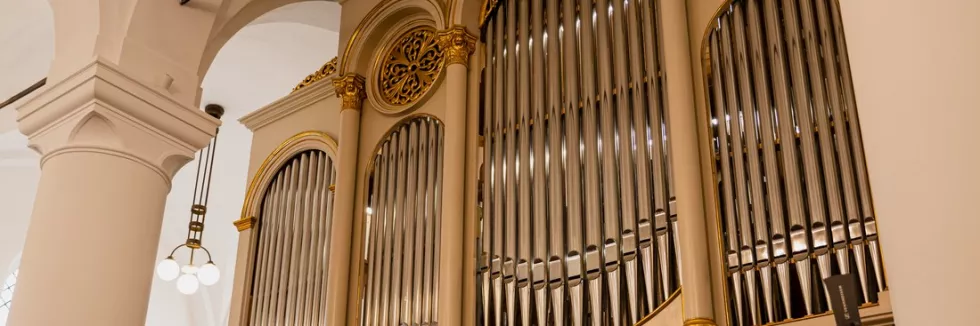
Church-Music-Masters-test-a-famous-church-organ-in-hungary

10 questions · two minutes

1. What does your daily practice on your instrument (organ, piano) or your voice look like?

2. You’re preparing the music for a service. Where do you start?

3. You have to run a rehearsal for an amateur parish choir, and some members can’t read music. What do you do?

4. How do you feel about Gregorian chant and early church music?

5. At a masterclass taught in English, you work alongside musicians from different countries while the tutor discusses how to interpret a piece. How do you feel?

6. During a service, the order of hymns suddenly changes or there’s an unexpected gap to fill with music. How do you react?

7. Are you interested in the history and construction of the organ?

8. Someone asks you to write a simple choral arrangement of a hymn. How do you respond?

9. How do you see the role of music in worship?

10. What motivates you most to pursue a Master’s degree in Church Music?

⇑Definitions and quotes

Music
Music is an art form and cultural activity whose medium is sound organized in time. The common elements of music are pitch (which governs melody and harmony), rhythm (and its associated concepts tempo, meter, and articulation), dynamics (loudness and softness), and the sonic qualities of timbre and texture (which are sometimes termed the "color" of a musical sound). Different styles or types of music may emphasize, de-emphasize or omit some of these elements. Music is performed with a vast range of instruments and vocal techniques ranging from singing to rapping; there are solely instrumental pieces, solely vocal pieces (such as songs without instrumental accompaniment) and pieces that combine singing and instruments. The word derives from Greek μουσική (mousike; "art of the Muses"). See glossary of musical terminology.
Music
One whom the music of his own vain tongue
Doth ravish like enchanting harmony.
William Shakespeare, Love's Labour's Lost (c. 1595-6), Act I, scene 1, line 167.
Church
The nere to the churche, the ferther from God.
The nearer to the church, the farther from God.
Church
The Churches as Churches have always been and cannot fail to be institutions not only alien to, but directly hostile towards, Christ's teaching.
Leo Tolstoy, The Kingdom of God is Within You (1894)

Contact:

ul. Kanonicza 25
31-002 Kraków
phone: (48 12) 88 98 617
StudentNews Group Websites for students and future students — in Poland since 2007, across Europe since 2014. Over 50 websites and millions of users a year (Google Analytics). Studies in Europe Universities in Europe Bachelor’s Master’s Doctorate MBA Study guide Work abroad Travel For partners Advertising and cooperation Reach (online report) Contact advertising@studentnews.eu © 2003–2026 Grupa StudentNews.pl sp. z o.o., Modlnica, Poland
Privacy Policy