
Lublin, Poland

Medical Biology
(field of studies: Biology)

Biologia medyczna

Bachelor's
Table of contents
europeana-8YVlsRDPHjE-unsplash

⇑Medical Biology at UMCS

Field of studies: Biology
Language: PolishStudies in Polish
Subject area: biology
Kind of studies: full-time studies
  • Description:

  • pl
University website: www.umcs.pl/en

⇑Why choose the Medical Biology specialisation at UMCS?

Dlaczego warto studiować na UMCS
Why study it:

Medical Biology is a specialisation within the Biology programme (bachelor's, first-cycle studies) at Maria Curie-Skłodowska University in Lublin. It is taught in English and suits you if you are curious about the human body in health and disease and would like to study biology with a view to medicine or laboratory work.

Programme: what you study

The programme covers the basic disciplines of biology and biomedical sciences, including:

  • microbiology, human anatomy and parasitology;
  • genetics with elements of human genetics and human immunology with elements of virology;
  • biochemistry of nutrition and biochemical methods in clinical analysis;
  • elements of pathophysiology, basics of pharmacology and radiology;
  • physical basis of instrumental diagnostics and physiotherapy;
  • biological basics of phytotherapy, pharmacological botany and biomaterial engineering in medicine.

Specialisation: an academic bridge towards medicine

The Medical Biology programme was designed as an academic bridge, a kind of premedical study, for people who want to become physicians but have not taken introductory natural science courses before. It builds the knowledge needed to enter professional medical programmes and helps to meet the requirements of the MD programme. At the same time it gives a broad foundation in biology, so you are not limited to one path. After this specialisation you can apply biological knowledge in modern medicine and you learn the principles of premedical first aid, both in theory and in practice.

Labs: how you learn

Classes take several forms: lectures, exercises, laboratory classes, field classes and experimental scientific training, so theory goes together with work at the bench and outdoors.

Languages: studying in English

The programme is addressed mainly to foreign students and is taught in English. You study in an international group at the Faculty of Biology and Biotechnology and meet students from many countries. Admission is open to both Polish and international candidates.

Exchanges: a semester abroad

Student exchange programmes such as Erasmus+ let you spend one semester at a university abroad, among others in Belgium, France, Germany, Italy, Spain, Slovenia and Turkey.

After graduation: what next

After graduation you can:

  • work in medical laboratories, research institutions and sanitary-epidemiological stations;
  • enter careers in research and development and in science-based industries;
  • work in teaching or in medical biology;
  • continue your studies at master's level at UMCS, elsewhere in Poland or in other European Union countries, because the programme follows European teaching standards.

Based on the UMCS admissions page.

⇑Test: Is Medical Biology the right fit for you?

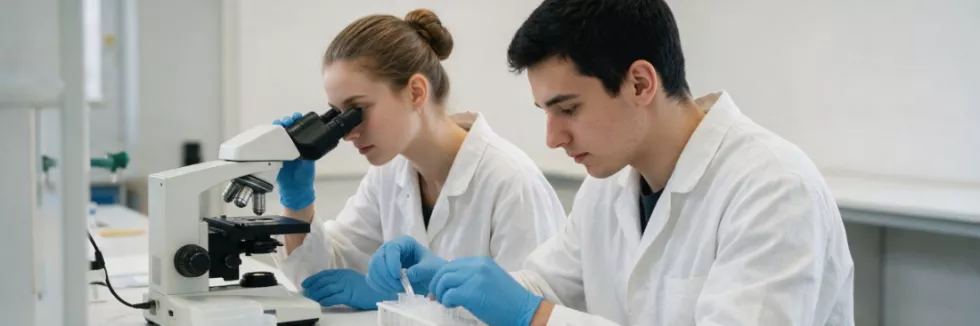
biology-students-examining-samples-under-a-microscope

10 questions · two minutes

1. How do you feel about looking at blood cells or tissue samples under a microscope and describing what you see?

2. You read that a certain gene variant increases the risk of a disease. What do you want to know?

3. How do you feel about precise lab work – pipetting tiny volumes, labelling samples and following protocols step by step?

4. Your experiment fails for the third time in a row. What do you do?

5. How do you feel about biochemistry – enzymes, metabolic pathways, molecular structures?

6. The programme is taught in English, and you’ll do lab classes with students from many countries. How do you feel about that?

7. How do you feel about working with cell cultures, bacteria or animal tissue in a lab?

8. You have results from forty samples and must decide whether the difference between two groups is real. What do you do?

9. Which future job appeals to you most?

10. What motivates you most to study Medical Biology?

⇑Definitions and quotes

Biology
Biology is the natural science that involves the study of life and living organisms, including their physical structure, chemical composition, function, development and evolution. Modern biology is a vast field, composed of many branches. Despite the broad scope and the complexity of the science, there are certain unifying concepts that consolidate it into a single, coherent field. Biology recognizes the cell as the basic unit of life, genes as the basic unit of heredity, and evolution as the engine that propels the creation of new species. Living organisms are open systems that survive by transforming energy and decreasing their local entropy to maintain a stable and vital condition defined as homeostasis. See glossary of biology.
Biology
Any competent biologist is aware of a multitude of problems yet unresolved and of questions yet unanswered. After all, biologic research shows no sign of approaching completion; quite the opposite is true. Disagreements and clashes of opinion are rife among biologists, as they should be in a living and growing science. Antievolutionists mistake, or pretend to mistake, these disagreements as indications of dubiousness of the entire doctrine of evolution. Their favorite sport is stringing together quotations, carefully and sometimes expertly taken out of context, to show that nothing is really established or agreed upon among evolutionists. Some of my colleagues and myself have been amused and amazed to read ourselves quoted in a way showing that we are really antievolutionists under the skin.
Theodosius Dobzhansky (1973) Nothing in Biology Makes Sense Except in the Light of Evolution, 1973 [1]
Biology
Purpose has no place in biology, but history has no meaning without it.
George Kubler The Shape of Time, 1982, p. 8
Biology
No biologist today would think of submitting a paper entitled "New evidence for evolution;" it simply has not been an issue for a century.
Douglas J. Futuyma, Evolutionary Biology, 2nd ed., 1986, Sinauer Associates, p. 15

Contact:

Pl. Marii Curie-Sklodowskiej 5
20-031 Lublin
Department of Education
International Students Office
phone: (+48) 81 537 29 26
facebook International Student Office


StudentNews Group Websites for students and future students — in Poland since 2007, across Europe since 2014. Over 50 websites and millions of users a year (Google Analytics). Studies in Europe Universities in Europe Bachelor’s Master’s Doctorate MBA Study guide Work abroad Travel For partners Advertising and cooperation Reach (online report) Contact advertising@studentnews.eu © 2003–2026 Grupa StudentNews.pl sp. z o.o., Modlnica, Poland
Privacy Policy