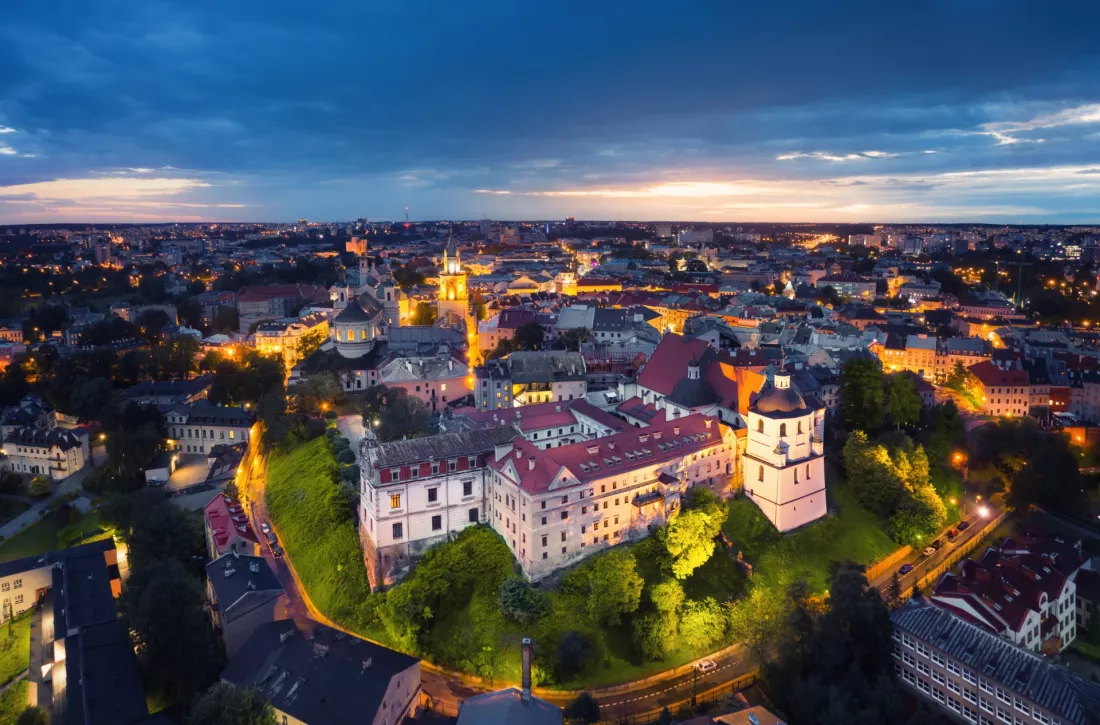
Lublin, Poland

Logistics

Logistyka

Master's
Table of contents
industrial-container-yard-logistics-business-transport-aircraft-import-export

⇑Logistics at UMCS

Language: PolishStudies in Polish
Subject area: economy and administration
Kind of studies: full-time studies, part-time studies
  • Description:

  • pl
University website: www.umcs.pl/en

⇑Test: Is Logistics the right fit for you?

supply-chain-managers-reviewing-a-tablet-in-a-distribution-centre-test

10 questions · two minutes

1. A key supplier’s factory suddenly stops production. How do you respond?

2. You’re asked to design a distribution network – how many warehouses and where. How do you approach it?

3. Sales want very high product availability, while finance wants lower inventory. What do you do?

4. Orders from retailers swing far more than actual consumer demand. What’s going on, and what would you do?

5. The programme is taught in English, in a group of graduates from many countries. How do you feel about that?

6. A company is considering automating its warehouse. What’s your role?

7. The company needs to measure and cut its supply chain emissions. How do you respond?

8. How do you feel about simulation models or linear programming for logistics decisions?

9. You’re negotiating a contract with a logistics service provider. What matters most to you?

10. What motivates you most to pursue a Master’s degree in Logistics?

⇑Definitions and quotes

Logistics
Logistics is generally the detailed organization and implementation of a complex operation. In a general business sense, logistics is the management of the flow of things between the point of origin and the point of consumption in order to meet requirements of customers or corporations. The resources managed in logistics can include physical items such as food, materials, animals, equipment, and liquids; as well as abstract items, such as time and information. The logistics of physical items usually involves the integration of information flow, materials handling, production, packaging, inventory, transportation, warehousing, and often security.
Logistics
Hannibal excelled as a tactician. No battle in history is a finer sample of tactics than Cannae. But he was yet greater in logistics and strategy. No captain ever marched to and fro among so many armies of troops superior to his own numbers and material as fearlessly and skillfully as he. No man ever held his own so long or so ably against such odds. Constantly overmatched by better soldiers, led by generals always respectable, often of great ability, he yet defied all their efforts to drive him from Italy, for half a generation. … As a soldier, in the countenance he presented to the stoutest of foes and in the constancy he exhibited under the bitterest adversity, Hannibal stands alone and unequaled. As a man, no character in history exhibits a purer life or nobler patriotism.
Theodore Ayrault Dodge, in Hannibal : A History of the Art of War among the Carthaginians and Romans (1893), p. 652
Logistics
Decision theory can be pursued not only for the purposes of building foundations for political economy, or of understanding and explaining phenomena that are in themselves intrinsically interesting, but also for the purpose of offering direct advice to business and governmental decision makers. For reasons not clear to me, this territory was very sparsely settled prior to World War II. Such inhabitants as it had were mainly industrial engineers, students of public administration, and specialists in business functions, none of whom especially identified themselves with the economic sciences. Prominent pioneers included the mathematician, Charles Babbage, inventor of the digital computer, the engineer, Frederick Taylor and the administrator, Henri Fayol.
During World War II, this territory, almost abandoned, was rediscovered by scientists, mathematicians, and statisticians concerned with military management and logistics, and was renamed “operations research” or “operations analysis.” So remote were the operations researchers from the social science community that economists wishing to enter the territory had to establish their own colony, which they called “management science”.
Herbert A. Simon, "Rational decision making in business organizations." Nobel Prize lecture 1978, published in: The American economic review 69(4) (1979): 493-513;
Logistics
It would be foolish to describe the logistics hub as merely ugly, for it has the horrifying, soulless, immaculate beauty characteristic of many of the workplaces of the modern world.
Alain de Botton The Pleasures and Sorrows of Work (2009) p. 39

Contact:

Pl. Marii Curie-Sklodowskiej 5
20-031 Lublin
Department of Education
International Students Office
phone: (+48) 81 537 29 26
facebook International Student Office


Privacy Policy