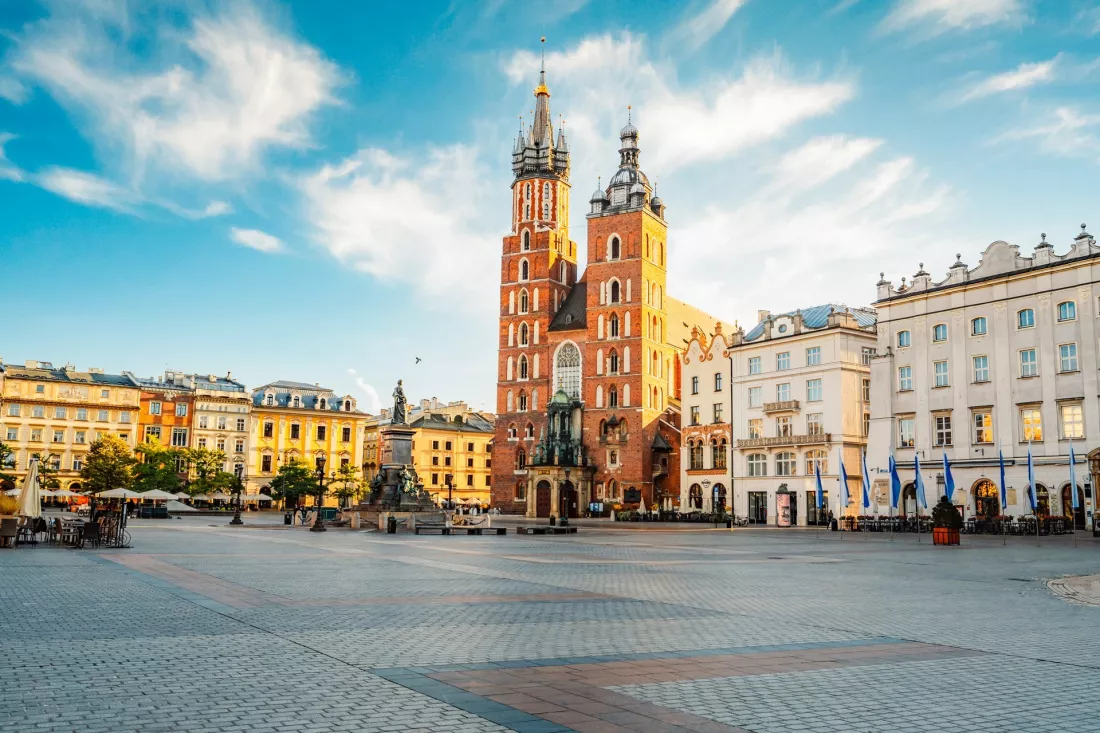
Cracow, Poland

Sustainable Chemistry

Chemia zrównoważonego rozwoju

Bachelor's
Table of contents

Sustainable Chemistry at UJ

Language: PolishStudies in Polish
Subject area: physical science, environment
Kind of studies: full-time studies
  • Description:

  • pl

Test: check whether Sustainable Development Chemistry is the right major for you!

Chemia zrównoważonego rozwoju test

Find Out if Sustainable Development Chemistry Is the Right Major for You!

1. Are you passionate about reducing environmental impact through chemical innovation?

2. Do you enjoy learning about green chemistry principles like waste minimization, benign solvents, and energy efficiency?

3. Are you interested in lifecycle analysis and evaluating the full environmental footprint of products?

4. Do you enjoy hands-on lab work developing or testing sustainable materials, catalysts, or processes?

5. Are you comfortable integrating knowledge from chemistry, environmental science, and policy to solve complex problems?

6. Do you care about ethical decision-making in deploying chemical solutions that affect people and ecosystems?

7. Do you enjoy analyzing data to assess sustainability metrics and improve processes?

8. Are you interested in developing renewable feedstocks or biodegradable products?

9. Do you like working collaboratively with scientists, engineers, and stakeholders to implement sustainable solutions?

10. Are you motivated by long-term environmental outcomes rather than short-term gains?

Definitions and quotes

Chemistry
Chemistry is the scientific discipline involved with compounds composed of atoms, i.e. elements, and molecules, i.e. combinations of atoms: their composition, structure, properties, behavior and the changes they undergo during a reaction with other compounds. Chemistry addresses topics such as how atoms and molecules interact via chemical bonds to form new chemical compounds. There are four types of chemical bonds: covalent bonds, in which compounds share one or more electron(s); ionic bonds, in which a compound donates one or more electrons to another compound to produce ions (cations and anions); hydrogen bonds; and Van der Waals force bonds.
Chemistry
Every chemical substance, whether natural or artificial, falls into one of two major categories, according to the spatial characteristic of its form. The distinction is between those substances that have a plane of symmetry and those that do not. The former belong to the mineral, the latter to the living world.
Louis Pasteur, Vallery-Radot (ed.), Oeuvres de Pasteur (1922-1939), Vol. I, 331. Quoted in Patrice Debré, Louis Pasteur, trans. Elborg Forster (1994), 261.
Chemistry
We can no more have exact religious thinking without theology, than exact mensuration and astronomy without mathematics, or exact iron-making without chemistry,
John Hall (Presbyterian pastor) (1895) Dictionary of Burning Words of Brilliant Writers p. 580.
Chemistry
It is a mistake to confound Alchemy with Chemistry. Modern Chemistry is a science which deals merely with the external forms in which the element of matter is manifesting itself. It never produces anything new. We may mix and compound and decompose two or more chemical bodies an unlimited number of times, and cause them to appear under various different forms, but at the end we will have no augmentation of substance, nor anything more than the combinations of the substances that have been employed at the beginning. Alchemy does not mix or compound anything, it causes that which already exists in a latent state to become active and grow. Alchemy is, therefore, more comparable to botany or agriculture than to Chemistry; and, in fact, the growth of a plant, a tree, or an animal is an alchemical process going on in the alchemical laboratory of nature, and performed by the great Alchemist, the power of God acting in nature.
Franz Hartmann. (1890) In the Pronaos of the Temple of Wisdom, containing the History of the True and the False Rosicrucians. p. 129


Contact:

phone (+48 12) 663 11 00
Gołębia str. 24
31-007 Kraków
Privacy Policy