Warsaw, Poland

Environmental Protection

Ochrona środowiska

Master's
Table of contents
gaf-clickz-gryMACx9reI-unsplash

⇑Environmental Protection at SGGW

Language: PolishStudies in Polish
Subject area: physical science, environment
Kind of studies: full-time studies
  • Description:

  • pl
University website: www.sggw.edu.pl/en

⇑Why study Environmental Protection (Master's) at the Warsaw University of Life Sciences – SGGW?

Dlaczego warto studiować w Szkole Głównej Gospodarstwa Wiejskiego w Warszawie
Why study it:

Environmental Protection at the Warsaw University of Life Sciences – SGGW is a second-cycle programme taught in English, lasting 1.5 years (three semesters) and leading to the title of Master. It is designed for people who want to understand how the environment degrades and how it can be protected.

Programme: hazards, data and environmental decisions

The programme prepares you to identify environmental hazards, collect and analyse environmental data, make environmental decisions and apply protection techniques and technologies. You learn about the physical, chemical and biological processes in nature, and about the causes and mechanisms of degradation of its elements. Subjects include methodology of environmental research, ecotoxicology, landscape ecology, GIS modelling, modelling of environmental processes, contaminant flow in the environment, noise protection, riparian ecosystems conservation and risk analysis. You also learn how environmental protection fits into the legal system of Poland and the European Union, and how to assess the impact of technical, agricultural and forest activity.

Specialisation: Restoration and Management of Environment

The programme is offered with the Restoration and Management of Environment specialisation, which adds electives on remediation and restoration, and diploma seminars devoted to it.

After graduation: municipal, public and consulting careers

Graduates can find work in:

  • municipal economy enterprises and industrial plants,
  • national and regional funds for environmental protection and water management,
  • central and local government administration,
  • design offices, construction firms and consulting companies,
  • educational institutions and research institutes.

Based on the programme pages at sggw.edu.pl and the SGGW syllabus.

⇑Test: Is Environmental Protection the right fit for you?

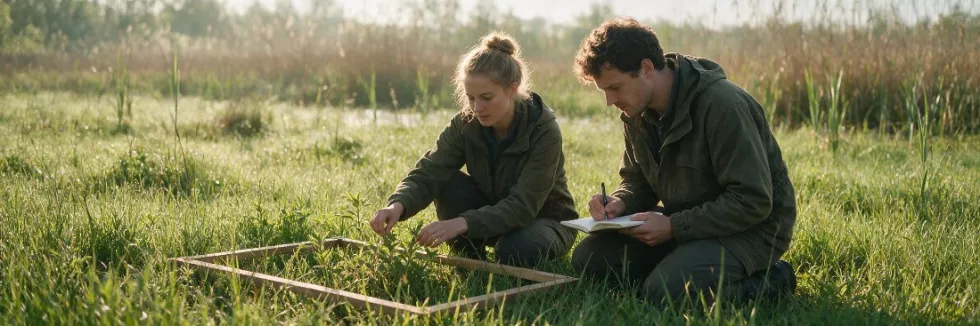
environmental-protection-graduates-surveying-wetland-plants-test

10 questions · two minutes

1. A developer plans a road through a wetland, and you’re asked to help with the environmental impact assessment. How do you approach it?

2. How do you feel about long days of fieldwork – counting birds, mapping plants or sampling soil?

3. You receive long-term air quality monitoring data for a region. What do you do with it?

4. How interested are you in environmental law and policy?

5. Lectures, fieldwork and projects are in English, in a group of graduates from many countries. How does that sound?

6. Local residents oppose protecting a forest because they depend on logging. How do you respond?

7. Would you like to write a thesis on, for example, how invasive species affect native ecosystems?

8. A company asks you to help reduce its environmental footprint. What do you do?

9. How do you react to alarming headlines about the state of the environment?

10. What motivates you most to pursue a Master’s degree in Environmental Protection?

⇑Definitions and quotes

Environmental Protection
Environmental protection is a practice of protecting the natural environment on individual, organization controlled or governmental levels, for the benefit of both the environment and humans. Due to the pressures of overconsumption, population and technology, the biophysical environment is being degraded, sometimes permanently. This has been recognized, and governments have begun placing restraints on activities that cause environmental degradation. Since the 1960s, activity of environmental movements has created awareness of the various environmental problems. There is no agreement on the extent of the environmental impact of human activity and even scientific dishonesty occurs, so protection measures are occasionally debated.
Protection
A man wants no protection when his conduct is strictly right.
William Murray, 1st Earl of Mansfield, Bird v. Gunston (1785), 3 Doug. 275; reported in James William Norton-Kyshe, Dictionary of Legal Quotations (1904), p. 212.
Protection
To protect those who are not able to protect themselves is a duty which every one owes to society.
Lord Macnaghten‎, Jenoure v. Delmege (1890), 60 L. J. Rep. (N. S.) Q. B. 13; reported in James William Norton-Kyshe, Dictionary of Legal Quotations (1904), p. 212.
Protection
It is true that the theory of our Constitution is, that all taxes are paid voluntarily; that our government is a mutual insurance company, voluntarily entered into by the people with each other; that each man makes a free and purely voluntary contract with all others who are parties to the Constitution, to pay so much money for so much protection, the same as he does with any other insurance company; and that he is just as free not to be protected, and not to pay any tax, as he is to pay a tax, and be protected.
But this theory of our government is wholly different from the practical fact.  The fact is that the government, like a highwayman, says to a man: Your money, or your life.  And many, if not most, taxes are paid under the compulsion of that threat.
The government does not, indeed, waylay a man in a lonely place, spring upon him from the road side, and, holding a pistol to his head, proceed to rifle his pockets.  But the robbery is none the less a robbery on that account; and it is far more dastardly and shameful.
The highwayman takes solely upon himself the responsibility, danger, and crime of his own act.  He does not pretend that he has any rightful claim to your money, or that he intends to use it for your own benefit.  He does not pretend to be anything but a robber.  He has not acquired impudence enough to profess to be merely a "protector," and that he takes men's money against their will, merely to enable him to "protect" those infatuated travellers, who feel perfectly able to protect themselves, or do not appreciate his peculiar system of protection.  He is too sensible a man to make such professions as these.  Furthermore, having taken your money, he leaves you, as you wish him to do.  He does not persist in following you on the road, against your will; assuming to be your rightful "sovereign," on account of the "protection" he affords you.  He does not keep "protecting" you, by commanding you to bow down and serve him; by requiring you to do this, and forbidding you to do that; by robbing you of more money as often as he finds it for his interest or pleasure to do so; and by branding you as a rebel, a traitor, and an enemy to your country, and shooting you down without mercy, if you dispute his authority, or resist his demands.  He is too much of a gentleman to be guilty of such impostures, and insults, and villainies as these.  In short, he does not, in addition to robbing you, attempt to make you either his dupe or his slave.
The proceedings of those robbers and murderers, who call themselves "the government," are directly the opposite of these of the single highwayman.
In the first place, they do not, like him, make themselves individually known; or, consequently, take upon themselves personally the responsibility of their acts.  On the contrary, they secretly (by secret ballot) designate some one of their number to commit the robbery in their behalf, while they keep themselves practically concealed.
Lysander Spooner, No Treason (1867–1870), No. VI: The Constitution of No Authority (1870), pp. 12–13.


Contact:

Nowoursynowska 166 str.
02-787 Warszawa
tel. (48 22) 59 31 000
StudentNews Group Websites for students and future students — in Poland since 2007, across Europe since 2014. Over 50 websites and millions of users a year (Google Analytics). Studies in Europe Universities in Europe Bachelor’s Master’s Doctorate MBA Study guide Work abroad Travel For partners Advertising and cooperation Reach (online report) Contact advertising@studentnews.eu © 2003–2026 Grupa StudentNews.pl sp. z o.o., Modlnica, Poland
Privacy Policy