Bielsko-Biała, Poland

Environmental Engineering

Inżynieria środowiska

Master's
Table of contents
Environmental Engineering study

⇑Environmental Engineering at UBB

Language: PolishStudies in Polish
Subject area: physical science, environment
Kind of studies: full-time studies, part-time studies
University website: ubb.edu.pl/en

⇑Test: Is Environmental Engineering the right fit for you?

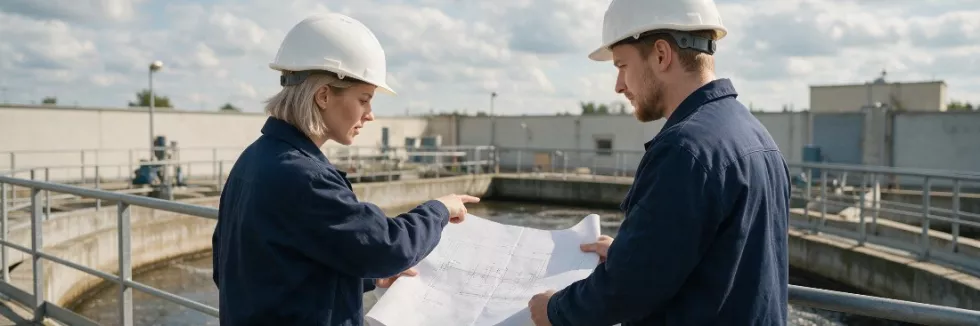
environmental-engineers-reviewing-plans-at-treatment-plant-test

10 questions · two minutes

1. You’re asked to design an upgrade of a wastewater treatment plant for a growing town. How do you start?

2. How comfortable are you with numerical modelling, such as groundwater flow or air pollution dispersion?

3. A project has to balance environmental targets, a tight budget and residents’ objections. What do you do?

4. Would you like to write a thesis on, for example, recovering energy from sewage sludge or removing micropollutants from water?

5. The programme is taught in English, and your classmates are engineers from different countries who know different regulations and technologies. How do you see that?

6. Your stormwater design is rejected at a regulatory review. How do you respond?

7. How do you feel about life cycle assessment and carbon footprint calculations?

8. Would you like to lead a team of engineers on an infrastructure project?

9. Nature-based solutions and smart water networks are gaining ground. How do you react?

10. What motivates you most to pursue a Master’s degree in Environmental Engineering?

⇑Definitions and quotes

Engineering
Engineering is the creative application of science, mathematical methods, and empirical evidence to the innovation, design, construction, operation and maintenance of structures, machines, materials, devices, systems, processes, and organizations. The discipline of engineering encompasses a broad range of more specialized fields of engineering, each with a more specific emphasis on particular areas of applied mathematics, applied science, and types of application. See glossary of engineering.
Engineering
Engineering is the conscious application of science to the problem of economic production.
Halbert Powers Gillette (1910). cited in: T.J. Hoover & J.C. Lounsbury Fish. The Engineering Profession. Stanford University Press, 1941. p. 463
Engineering
These experiences are not 'religious' in the ordinary sense. They are natural, and can be studied naturally. They are not 'ineffable' in the sense the sense of incommunicable by language. Maslow also came to believe that they are far commoner than one might expect, that many people tend to suppress them, to ignore them, and certain people seem actually afraid of them, as if they were somehow feminine, illogical, dangerous. 'One sees such attitudes more often in engineers, in mathematicians, in analytic philosophers, in book keepers and accountants, and generally in obsessional people'.
The peak experience tends to be a kind of bubbling-over of delight, a moment of pure happiness. 'For instance, a young mother scurrying around her kitchen and getting breakfast for her husband and young children. The sun was streaming in, the children clean and nicely dressed, were chattering as they ate. The husband was casually playing with the children: but as she looked at them she was suddenly so overwhelmed with their beauty and her great love for them, and her feeling of good fortune, that she went into a peak experience . . .
Colin Wilson in New Pathways In Psychology, p. 17
Engineering
A key characteristic of the engineering culture is that the individual engineer’s commitment is to technical challenge rather than to a given company. There is no intrinsic loyalty to an employer as such. An employer is good only for providing the sandbox in which to play. If there is no challenge or if resources fail to be provided, the engineer will seek employment elsewhere. In the engineering culture, people, organization, and bureaucracy are constraints to be overcome. In the ideal organization everything is automated so that people cannot screw it up. There is a joke that says it all. A plant is being managed by one man and one dog. It is the job of the man to feed the dog, and it is the job of the dog to keep the man from touching the equipment. Or, as two Boeing engineers were overheard to say during a landing at Seattle, “What a waste it is to have those people in the cockpit when the plane could land itself perfectly well.” Just as there is no loyalty to an employer, there is no loyalty to the customer. As we will see later, if trade-offs had to be made between building the next generation of “fun” computers and meeting the needs of “dumb” customers who wanted turnkey products, the engineers at DEC always opted for technological advancement and paid attention only to those customers who provided a technical challenge.
Edgar H. Schein (2010). Dec Is Dead, Long Live Dec: The Lasting Legacy of Digital Equiment Corporation. p. 60
Privacy Policy