Kielce, Poland

Stage Music

Muzyka estradowa

Bachelor's
Table of contents
stage-before

⇑Stage Music at UJK

Language: PolishStudies in Polish
Subject area: arts
Kind of studies: full-time studies
University website: ujk.edu.pl/ujk_-_english.html

⇑Test: Is Stage music the right fit for you?

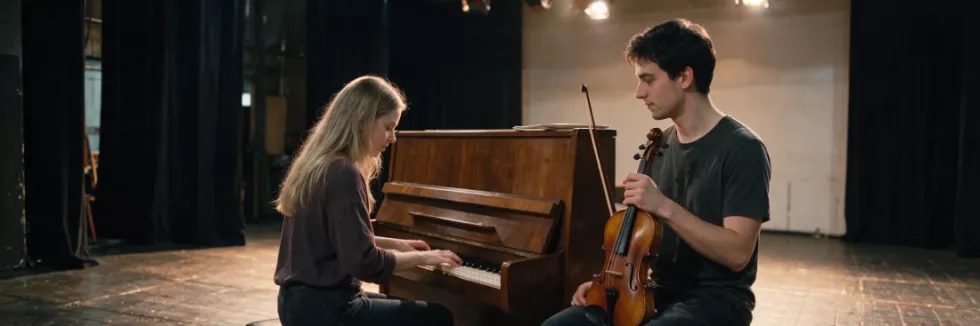
music-students-rehearsing-piano-and-violin-on-a-theatre-stage

10 questions · two minutes

1. A director asks you to compose a short piece that builds tension before a key scene in a play. How do you feel?

2. How do you feel about long rehearsals, repeating the same scene until the music fits the actors’ movements?

3. When you watch a musical or a play, what do you notice?

4. How do you feel about learning harmony, orchestration and music theory in depth?

5. During a live show an actor skips several lines while you’re playing the accompaniment. What do you do?

6. Which project would you choose?

7. The programme is taught in English, and you’ll create performances with students from many countries. How do you feel about that?

8. How do you feel about working closely with directors, choreographers and sound engineers and taking their feedback?

9. Which future role sounds most like you?

10. What motivates you most to study Stage music?

⇑Definitions and quotes

Music
Music is an art form and cultural activity whose medium is sound organized in time. The common elements of music are pitch (which governs melody and harmony), rhythm (and its associated concepts tempo, meter, and articulation), dynamics (loudness and softness), and the sonic qualities of timbre and texture (which are sometimes termed the "color" of a musical sound). Different styles or types of music may emphasize, de-emphasize or omit some of these elements. Music is performed with a vast range of instruments and vocal techniques ranging from singing to rapping; there are solely instrumental pieces, solely vocal pieces (such as songs without instrumental accompaniment) and pieces that combine singing and instruments. The word derives from Greek μουσική (mousike; "art of the Muses"). See glossary of musical terminology.
Music
We get nearer to the Lord through music than perhaps through any other thing except prayer.
J. Reuben Clark, LDS Conference Report, Oct. 1936.
Music
And music too—dear music! that can touch
Beyond all else the soul that loves it much—
Now heard far off, so far as but to seem
Like the faint, exquisite music of a dream.
Thomas Moore, Lalla Rookh (1817), The Veiled Prophet of Khorassan.
Music
A chord is by no means an agglomeration of intervals. It is a new unit which, although dependent on the formative power of the single interval, is felt as being self-existent and as giving to the constituent intervals meanings and functions which they otherwise would not have.
Paul Hindemith (1952: 72). A Composer's World. Cambridge, Mass.
Privacy Policy