
Częstochowa, Poland

Sustainable Energy Technologies
(field of studies: Innovative Technologies and Advanced Materials)

Zrównoważone technologie energetyczne

Bachelor's - engineer
Table of contents
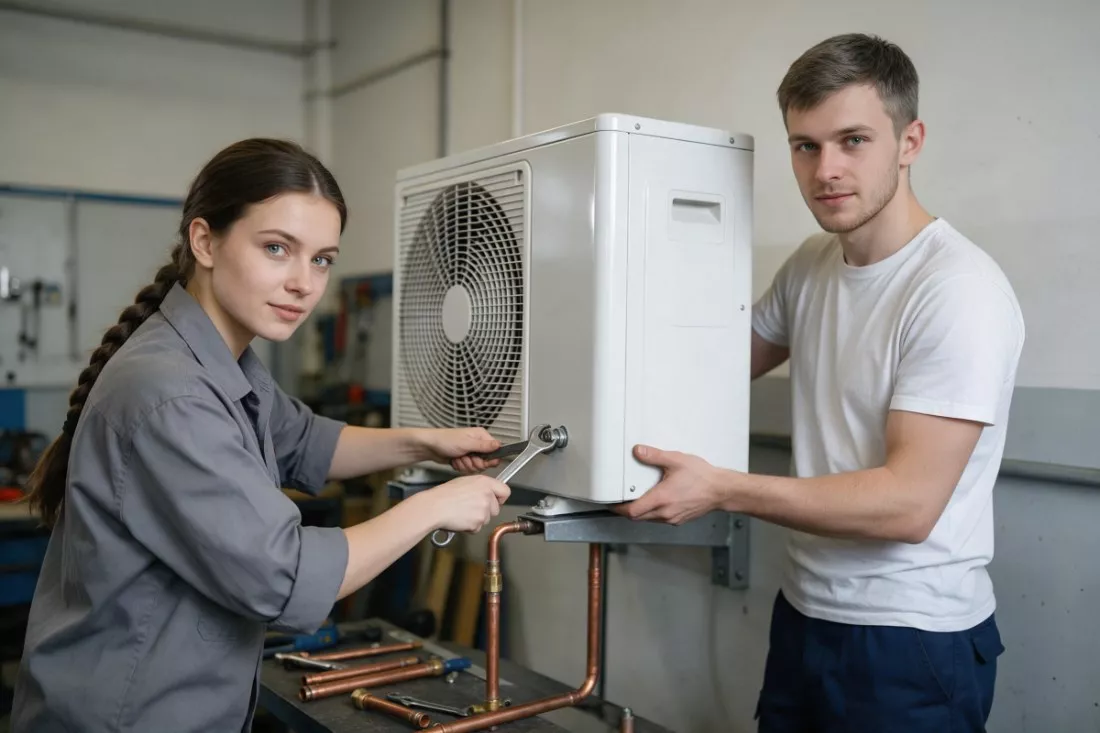
studenci-montuja-pompe-ciepla-w-warsztacie

⇑Sustainable Energy Technologies at UJD

Language: PolishStudies in Polish
Subject area: engineering and engineering trades
Kind of studies: full-time studies, part-time studies
  • Description:

  • pl
University website: www.en.ujd.edu.pl

⇑Why choose the Sustainable Energy Technologies specialisation at UJD?

Dlaczego warto studiować na UJD
Why study it:

Sustainable Energy Technologies is a specialisation in the Innovative Technologies and Advanced Materials programme (first-cycle engineering studies) at Jan Długosz University in Częstochowa. It is a good fit if you want to design, measure and assess energy solutions, from the audit of a building to renewable installations, and to do it in English.

Programme: what the specialisation block covers

The block opens with an energy audit workshop. You learn the types of audits for industrial, residential and commercial buildings, assess energy efficiency, find the areas that consume most, and write audit reports with recommendations. A course on sustainable materials and the circular economy builds on life cycle analysis of a product, the choice of materials and recycling strategies, and ends with an implementation plan for a small manufacturing company.

Energy sources get courses of their own. Elements of nuclear energy go through radioactive decay, ionising radiation, radiation shielding and the energy balance of fission. The wind and hydropower course teaches how to design an installation for local conditions, estimate its energy output and prepare technical documentation.

Specialisation: energy instead of machining

A path about energy, not about product design: you work on saving, generating and managing energy, while the other specialisation of the programme, Virtual Prototyping, focuses on computer-aided design and CNC manufacturing. You choose between them after the second semester.

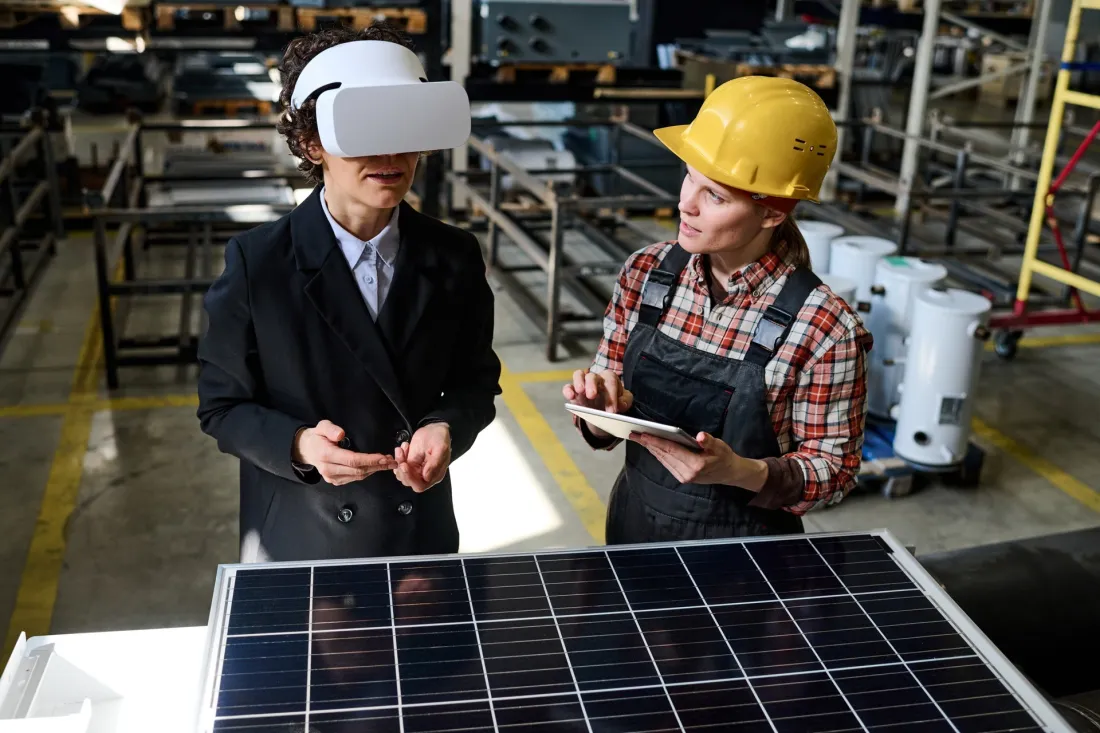
Labs: measurements on solar and hybrid systems

In the courses on hybrid and solar systems you work on measurements, for example:

  • configuring and analysing the operation of photovoltaic and wind installations;
  • measuring the current–voltage characteristics of photovoltaic modules;
  • checking how panel tilt angle and temperature change efficiency;
  • monitoring and optimising hybrid photovoltaic and solar thermal systems;
  • diagnosing solar collectors in laboratory conditions and writing diagnostic reports.

After graduation: where the specialisation leads

Graduates may work as renewable energy engineers and specialists, energy auditors, specialists in hybrid energy systems and energy storage, energy efficiency consultants or experts in the circular economy. The programme is practical, and professional internships are part of its study plan, so you meet the workplace before you graduate.

Based on the study plan and the UJD admissions page.
⇑Test: Is Sustainable Energy Technologies the right fit for you?

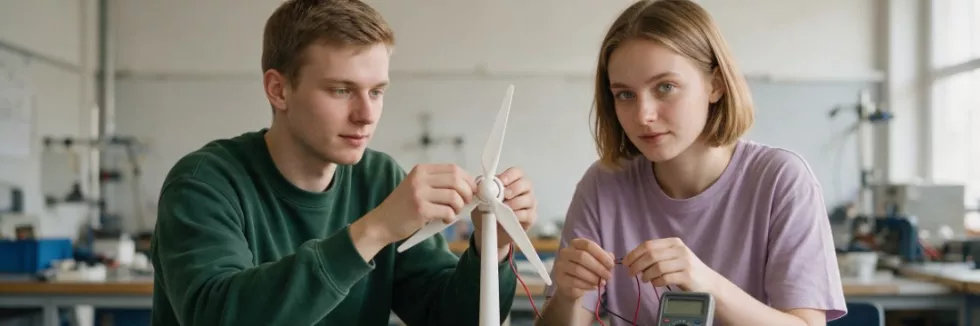
students-assembling-a-small-model-wind-turbine

10 questions · two minutes

1. In physics you’re covering energy conversion – how wind drives a turbine, for example. How do you feel about it?

2. Your neighbours are weighing up a heat pump or solar panels and ask what you think. What do you do?

3. Do you enjoy tinkering – assembling, fixing, building simple electrical circuits?

4. How do you get on with maths and chemistry?

5. Classes, labs and lab reports will be in English, with classmates from different countries. How does that sound?

6. The wind drops and the sun goes down. Have you ever wondered where the energy comes from then?

7. For a school project, you need to cut energy use in the school building. What do you do?

8. How do you react when a school lab experiment doesn’t work?

9. Where do you see yourself after graduating?

10. What motivates you most to study Sustainable Energy Technologies?

⇑Definitions and quotes

Energy
In physics, energy is the quantitative property that must be transferred to an object in order to perform work on, or to heat, the object. Energy is a conserved quantity; the law of conservation of energy states that energy can be converted in form, but not created or destroyed. The SI unit of energy is the joule, which is the energy transferred to an object by the work of moving it a distance of 1 metre against a force of 1 newton.
Sustainable Energy
Sustainable energy is energy that is consumed at insignificant rates compared to its supply and with manageable collateral effects, especially environmental effects. Another common definition of sustainable energy is an energy system that serves the needs of the present without compromising the ability of future generations to meet their needs. Renewable energy is not a synonym of sustainable energy. While renewable energy is defined as one that is naturally replenished on a human timescale, sustainable (often referred to as 'clean') energy is one the use of which will not compromise the system in which it is adopted to the point of not being fit to provide needs in the future. The organizing principle for sustainability is sustainable development, which includes the four interconnected domains: ecology, economics, politics and culture. Sustainability science is the study of sustainable development and environmental science.
Energy
We must proceed with our own energy development. Exploitation of domestic petroleum and natural gas potentialities, along with nuclear, solar, geothermal, and non-fossil fuels is vital. We will never again permit any foreign nation to have Uncle Sam over a barrel of oil.
Gerald Ford, speech to the Anti-Defamation League of B'nai B'rith, West Palm Beach, Florida (January 26, 1974); reported in Congressional Record (February 4, 1974), vol. 120, p. 2044.
Energy
You will soon be able to tax it.
Michael Faraday to William Gladstone on the future use of electricity
Energy
E = mc²
Albert Einstein, The equivalence of matter and energy was originally expressed by the equation m = L/c², which easily translates into the far more well known E = mc² in Does the Inertia of a Body Depend Upon Its Energy Content? published in the Annalen der Physik (27 September 1905) : "If a body gives off the energy L in the form of radiation, its mass diminishes by L/c²."

Contact:

Waszyngtona str. 4/8
42-200 Częstochowa
phone +48 34 378 41 00
StudentNews Group Websites for students and future students — in Poland since 2007, across Europe since 2014. Over 50 websites and millions of users a year (Google Analytics). Studies in Europe Universities in Europe Bachelor’s Master’s Doctorate MBA Study guide Work abroad Travel For partners Advertising and cooperation Reach (online report) Contact advertising@studentnews.eu © 2003–2026 Grupa StudentNews.pl sp. z o.o., Modlnica, Poland
Privacy Policy