

Częstochowa, Poland

Instrumental Performance
(field of studies: Music in Public Spaces)

Wykonawstwo instrumentalne

Bachelor's
Table of contents
cropped-image-musician-playing-saxophones

⇑Instrumental Performance at UJD

Field of studies: Music in Public Spaces
Language: PolishStudies in Polish
Subject area: arts
Kind of studies: full-time studies
  • Description:

  • pl
University website: www.en.ujd.edu.pl

⇑Why choose the Instrumental Performance specialisation at UJD?

Dlaczego warto studiować na UJD
Why study it:

Instrumental Performance is a specialisation within the Music in Public Space programme (first-cycle studies) at Jan Długosz University in Częstochowa. It suits you if you want to play piano, guitar, accordion or organ and build a career in classical music as a soloist or chamber musician.

Programme: what the specialist block contains

Next to general music training, the specialist courses include:

  • a main instrument of your choice – piano, guitar, accordion or organ – with exams based on performing a prepared repertoire;
  • chamber ensemble, where you learn to listen to your partners, shape a shared interpretation and get the group ready for public concerts;
  • vocal ensembles, with group singing and choral literature;
  • specialist literature, covering the history of your instrument and its original and transcribed repertoire across the eras;
  • musical analysis, from fugue and variations to sonata form, rondo and the concerto;
  • history of 20th and 21st-century music.

Specialisation: a path focused on classical performance

This specialisation is built around classical repertoire. You learn to perform varied instrumental music in the style that suits each piece, and you work with other musicians on shared performance concepts. Besides the core music education you pick up the basics of voice production and improvisation, and you learn how to initiate and organise cultural events. The two other paths of the programme lean elsewhere: Musical arts animation towards managing culture, Stage music towards jazz and the stage.

Labs: small groups and public performances

Classes run in small groups, so you stay in direct contact with teachers of your instrument, and the shared work leads to solo recitals, choir and ensemble concerts and competitions in Poland and abroad.

Languages: studying in English

The programme is taught in English, so classes in the specialist block and in the wider music curriculum are held in that language.

After graduation: where the path leads

You finish with a bachelor of arts degree and the preparation to work as an instrumentalist or chamber musician in the field of classical music.

The degree also opens the way to second-cycle studies, in case you want to keep developing your playing.

Based on the study plan and the UJD admissions page.
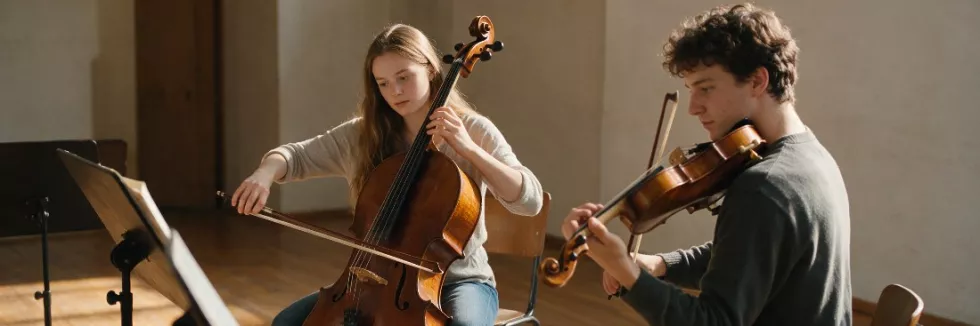
⇑Test: Is Instrumental Performance the right fit for you?

music-students-rehearsing-on-cello-and-violin-test

10 questions · two minutes

1. How many hours a day could you practise your instrument?

2. You have to perform a solo piece on stage in front of an audience. How do you feel?

3. There’s a difficult passage you just can’t master. What do you do?

4. How do you feel about playing in a chamber group or an orchestra?

5. You’re given a new piece to sight-read. How does it go?

6. Lessons and masterclasses are in English, with musicians from different countries. How do you feel about that?

7. How do you feel about harmony, music history and analysing a score?

8. Your teacher criticises your playing sharply in a lesson. How do you react?

9. You’re learning a piece that has been recorded by many famous performers. How do you approach it?

10. What motivates you most to study Instrumental Performance?

⇑Definitions and quotes

Instrumental
An instrumental is a musical composition or recording without lyrics, or singing, although it might include some inarticulate vocals, such as shouted backup vocals in a Big Band setting. The word "song" is widely misused by people in the popular music industry to describe any musical composition, whether sung or played only by instruments."The music is primarily or exclusively produced by musical instruments. An instrumental can exist in music notation, after it is written by a composer; in the mind of the composer (especially in cases where the composer himself will perform the piece, as in the case of a blues solo guitarist or a folk music fiddle player); as a piece that is performed live by a single instrumentalist or a musical ensemble, which could range in size from a duo or trio to a large Big Band, concert band or orchestra.
Performance
Performance is completion of a task with application of knowledge, skills and abilities. In work place, performance or job performance means good ranking with the hypothesized conception of requirements of a task role, whereas citizenship performance means a set of individual activity/contribution (prosocial organizational behavior) that supports the organizational culture. In the performing arts, a performance generally comprises an event in which a performer or group of performers present one or more works of art to an audience. Usually the performers participate in rehearsals beforehand. An effective performance is determined by competency of the performer - level of skill and knowledge. Spencer and McClelland in 1994 defined competency as "a combination of motives, traits, self-concepts, attitudes, cognitive behavior skills (content knowledge)" that helps a performer to differentiate themselves superior from average performers. A performance may also describe the way in which an actor performs. In a solo capacity, it may also refer to a mime artist, comedian, conjurer, or other entertainer.
Performance
"Performance has remained the ideal locus of rock authenticity long after it has ceased to be the real origin of rock music."
David R. Shumway (1999). "Performance". Key Terms in Popular Music and Culture. Malden, Massachusetts. ISBN 0631212639.
Performance
"For me, the most important thing is the element of chance that is built into a live performance. The very great drawback of recorded sound is the fact that it is always the same. No matter how wonderful a recording is, I know that I couldn't live with it -- even of my own music -- with the same nuances forever."
Aaron Copland, quoted in Classic Essays on Twentieth-Century Music. ISBN 0028645812.
Performance
"I hope my recordings of my own works won't inhibit other people's performances. The brutal fact is that one doesn't always get the exact tempo one wants, although one improves with experience."
Aaron Copland, quoted in Classic Essays on Twentieth-Century Music. ISBN 0028645812.

Contact:

Waszyngtona str. 4/8
42-200 Częstochowa
phone +48 34 378 41 00
StudentNews Group Websites for students and future students — in Poland since 2007, across Europe since 2014. Over 50 websites and millions of users a year (Google Analytics). Studies in Europe Universities in Europe Bachelor’s Master’s Doctorate MBA Study guide Work abroad Travel For partners Advertising and cooperation Reach (online report) Contact advertising@studentnews.eu © 2003–2026 Grupa StudentNews.pl sp. z o.o., Modlnica, Poland
Privacy Policy