
Warsaw, Poland

Robotics and Intelligent Autonomous Systems
(field of studies: Computer Science)

Robotyka i Inteligentne Systemy Autonomiczne

Bachelor's - engineer
Table of contents
studenci-testuja-autonomicznego-robota-mobilnego-w-laboratorium

⇑Robotics and Intelligent Autonomous Systems at PJATK

Field of studies: Computer Science
Language: PolishStudies in Polish
Subject area: engineering and engineering trades
Kind of studies: full-time studies, part-time studies
  • Description:

  • pl
University website: www.pja.edu.pl/en/

⇑Why choose the Robotics and Intelligent Autonomous Systems specialisation at the Polish-Japanese Academy of Information Technology?

Dlaczego warto studiować w Polsko-Japońskiej Akademii Technik Komputerowych
Why study it:

Robotics and Intelligent Autonomous Systems is a specialisation within the Computer Science programme, a full-time Bachelor's course taught in English at the Polish-Japanese Academy of Information Technology (PJAIT). It is for those who want to combine artificial intelligence with real hardware and build robots that perceive and decide on their own.

Programme: AI, machine vision and control

The specialisation focuses on mobile robotic systems that integrate artificial intelligence, machine learning and control algorithms. A key element is machine vision and the design of autonomous, intelligent systems. You learn to design and implement neural networks that analyse data, classify images and support decisions made by robots. Specialisation subjects are Intelligent Control Systems and Machine Vision, and in the penultimate semester you are encouraged to take the elective Knowledge Engineering Methods.

Specialisation: deep learning for robots

The programme applies deep learning techniques directly to robotics:

  • YOLO for real-time object detection in tracking and monitoring systems
  • U-Net for image segmentation, used in environment analysis and mapping
  • autoencoders and GANs for data generation and image reconstruction
  • graph machine learning and neuroevolution to fit models to robots with limited computing power and energy
  • natural language processing, so that robots can interpret spoken commands

Labs: robots, LIDAR and ROS

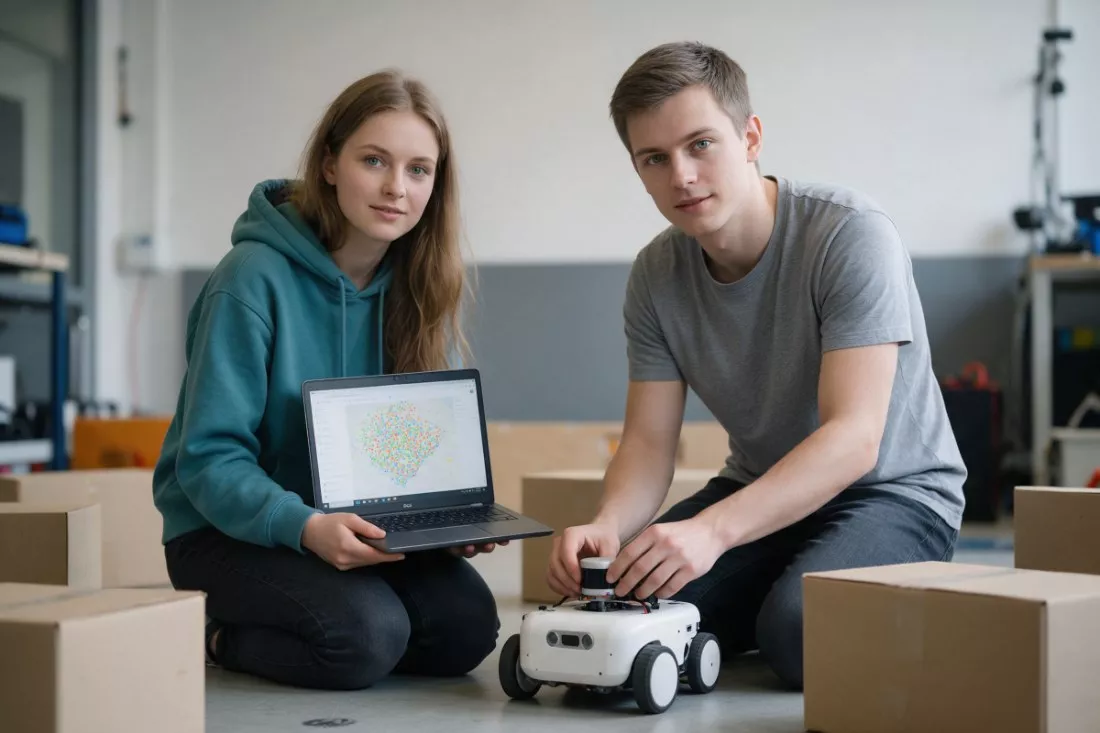
You work with real robots and standard industry tools. The laboratories offer mobile training robots, systems for low-level PID control, robots with LIDAR for mapping and localisation with SLAM algorithms, Roomba platforms, a NAO humanoid robot and Lego NXT robots, while the Robot Operating System (ROS), Python, PyTorch, Keras, scikit-learn and OpenCV are the everyday toolset.

After graduation: robotics and autonomous systems

Graduates are prepared to work in robotics, autonomous systems, artificial intelligence and control engineering, in sectors such as automation, the automotive industry with its autonomous cars, industrial robotics and monitoring systems.

Thesis topics are current and practical: camera-based object tracking, vision systems that support sports training, autonomous vehicles, the detection of road hazards, or localisation and navigation with SLAM algorithms.

Based on the programme pages at pja.edu.pl.

⇑Test: Is Robotics and Intelligent Autonomous Systems the right fit for you?

students-programming-a-robot-arm-to-pick-up-blocks

10 questions · two minutes

1. Have you ever built a robot, from a kit or with a microcontroller?

2. The robot vacuum at home keeps getting stuck under the sofa. What do you think?

3. How do you get on with maths and physics?

4. How do you feel about programming?

5. Lectures, labs and team projects will all be in English, in an international environment with students from many countries. How does that sound?

6. You read that robots can learn to grasp objects through trial and error. How do you react?

7. The day before a demo, your project stops working. What do you do?

8. A self-driving vehicle has to make its own decisions on the road. What does that make you think about?

9. What kind of work can you see yourself doing in future?

10. What motivates you most to study Robotics and Intelligent Autonomous Systems?

⇑Definitions and quotes

Robotics
Robotics is an interdisciplinary branch of engineering and science that includes mechanical engineering, electronics engineering, computer science, and others. Robotics deals with the design, construction, operation, and use of robots, as well as computer systems for their control, sensory feedback, and information processing.

Contact:

Koszykowa str. 86
02-008 Warsaw
phone: (+48) 22 58 44 500
fax: (+48) 22 58 44 501
StudentNews Group Websites for students and future students — in Poland since 2007, across Europe since 2014. Over 50 websites and millions of users a year (Google Analytics). Studies in Europe Universities in Europe Bachelor’s Master’s Doctorate MBA Study guide Work abroad Travel For partners Advertising and cooperation Reach (online report) Contact advertising@studentnews.eu © 2003–2026 Grupa StudentNews.pl sp. z o.o., Modlnica, Poland
Privacy Policy