Łódź, Poland

Cognitive Science

Kognitywistyka

Bachelor's
Table of contents
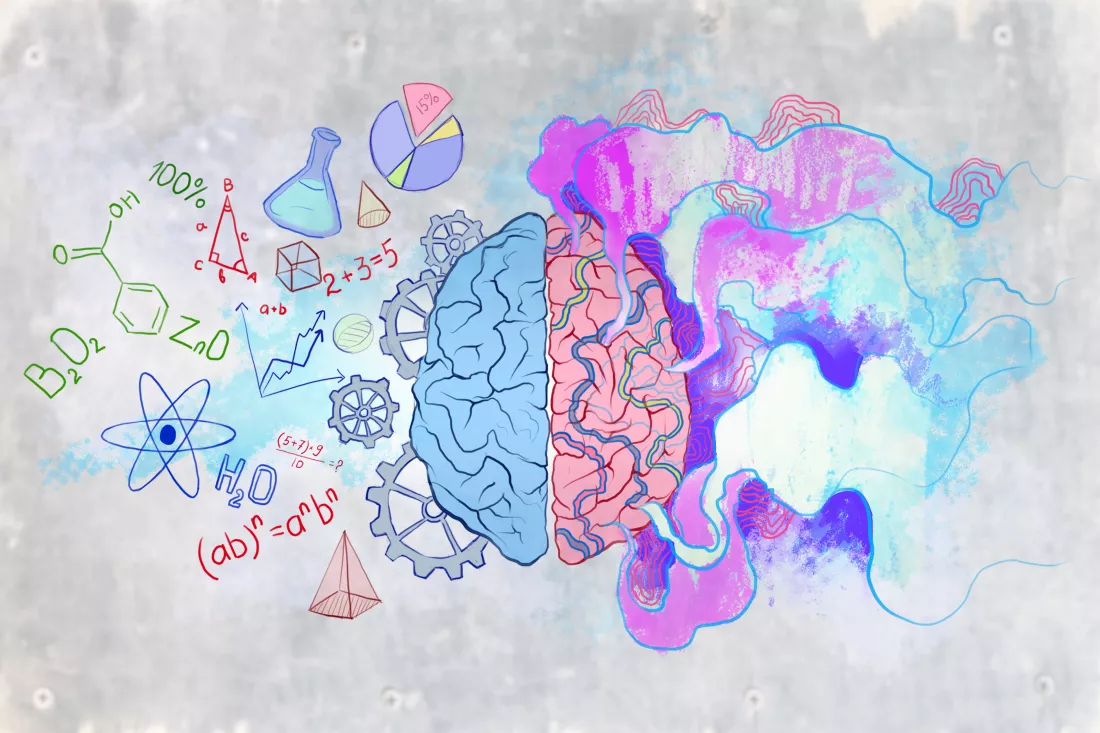
brain-sketch-half-painted-blue-orange-with-different-small-drawings-colorful-rays-white-background-brainstorm-creativity-concept-3d-rendering

Cognitive Science at AHE Łódź

Language: PolishStudies in Polish
Subject area: humanities
Kind of studies: full-time studies, part-time studies
  • Description:

  • pl

Test: check whether Cognitive Science is the right major for you!

magnifying-glass-with-human-brain

Test: check whether Cognitive Science is the right major for you!

1. Are you curious about how the mind works, including perception, memory, and decision-making?

2. Do you enjoy combining insights from psychology, computer science, linguistics, philosophy, or neuroscience?

3. Are you interested in using computational models or programming to simulate thought or behavior?

4. Do you enjoy analyzing language, communication patterns, or how meaning is constructed?

5. Are you comfortable interpreting experimental data and drawing inferences about mental processes?

6. Do you like thinking about ethical questions related to artificial intelligence, cognition, or human behavior?

7. Are you motivated by solving complex problems that require integrating different kinds of evidence?

8. Do you enjoy communicating abstract ideas clearly to others, both verbally and in writing?

9. Are you curious about how humans and machines can interact more effectively, such as through user interfaces or cognitive ergonomics?

10. Are you willing to adapt your understanding as new research and perspectives evolve in this fast-moving field?

Definitions and quotes

Cognitive Science
Cognitive science is the interdisciplinary, scientific study of the mind and its processes. It examines the nature, the tasks, and the functions of cognition (in a broad sense). Cognitive scientists study intelligence and behavior, with a focus on how nervous systems represent, process, and transform information. Mental faculties of concern to cognitive scientists include language, perception, memory, attention, reasoning, and emotion; to understand these faculties, cognitive scientists borrow from fields such as linguistics, psychology, artificial intelligence, philosophy, neuroscience, and anthropology. The typical analysis of cognitive science spans many levels of organization, from learning and decision to logic and planning; from neural circuitry to modular brain organization. The fundamental concept of cognitive science is that "thinking can best be understood in terms of representational structures in the mind and computational procedures that operate on those structures."
Science
Science (from Latin scientia, meaning "knowledge") is a systematic enterprise that builds and organizes knowledge in the form of testable explanations and predictions about the universe.
Science
Those (natural) laws cannot be circumvented by any amount of piety or cleverness, but they can be understood. Uncovering them should be the highest goal of a civilized society. Not, as we have seen, because scientists have any claim to greater intellect or virtue, but because the scientific method transcends the flaws of individual scientists. Science is the only way we have of separating the truth from ideology, or fraud, or mere foolishness.
Robert L. Park, Voodoo Science (2000), p. 211

Science
Science has an important part to play in our everyday existence, and there is far too much neglect of science; but its intention is to supplement not to supplant the familiar outlook.
Arthur Eddington, Science and the Unseen World (1929).
Science
Science is the topography of ignorance.
Oliver Wendell Holmes, Sr., Medical Essays, 211. Quotes reported in Hoyt's New Cyclopedia Of Practical Quotations (1922), p. 691-92.

Contact:

ul. Sterlinga 26
90-212 Łódź
More information is available at:
+48 42 63 15 840 / +48 42 63 15 841
Privacy Policy