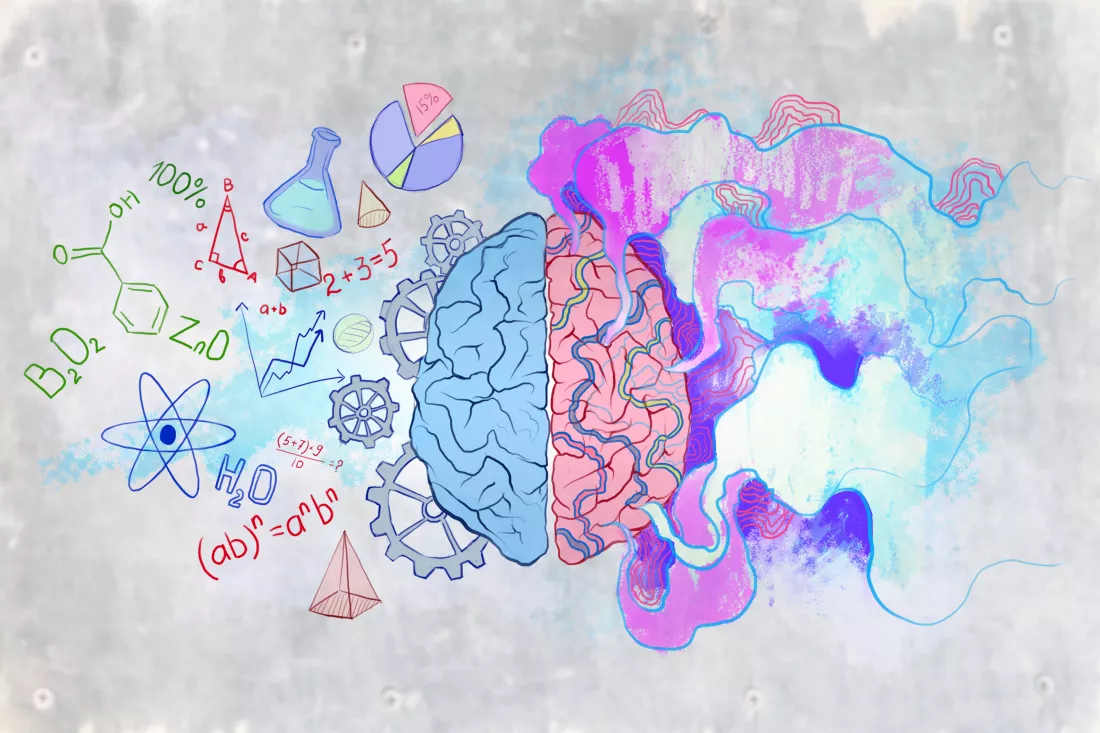
Cognitive Science
Cognitive science is the interdisciplinary, scientific study of the mind and its processes. It examines the nature, the tasks, and the functions of cognition (in a broad sense). Cognitive scientists study intelligence and behavior, with a focus on how nervous systems represent, process, and transform information. Mental faculties of concern to cognitive scientists include language, perception, memory, attention, reasoning, and emotion; to understand these faculties, cognitive scientists borrow from fields such as linguistics, psychology, artificial intelligence, philosophy, neuroscience, and anthropology. The typical analysis of cognitive science spans many levels of organization, from learning and decision to logic and planning; from neural circuitry to modular brain organization. The fundamental concept of cognitive science is that "thinking can best be understood in terms of representational structures in the mind and computational procedures that operate on those structures."
Science
The men in the laboratory... cannot be said to observe the actual objects of their curiosity at all. ...The sense data on which the propositions of modern science rest are, for the most part, little photographic spots and blurs, or inky curved lines on paper. ... What is directly observable is only a sign of the "physical fact"; it requires interpretation to yield scientific propositions.
Susanne Langer, Philosophy in a New Key (1942)
Science
Within the short span of a human life and with man's limited powers of memory, any stock of knowledge worthy of the name is unattainable except by the greatest mental economy. Science itself, therefore, may be regarded as a minimal problem, consisting of the completest possible presentment of facts with the least possible expenditure of thought.
Ernst Mach, The Science of Mechanics: A Critical and Historical Account of Its Development (1893) p. 490, Tr. Thomas J. McCormack.
Science
Take a look at George Gamow, who is now recognized as one of the great cosmologists of the last hundred years. I speculate that he probably didn't win the Nobel Prize because people could not take him seriously. He wrote children's books. His colleagues have publicly stated his writing children's books on science had an adverse effect on his scientific reputation, and people could not take him seriously when he and his colleagues proposed that there should be a cosmic background radiation, which we now know to be one of the greatest discoveries of 20th-century physics.
Michio Kaku, in "Borrowed Time: Interview with Michio Kaku".