Katowice, Poland

Sustainability and ESG Manager
(field of studies: Management)

Menadżer zrównoważonego rozwoju i ESG

Master's
Table of contents

⇑Sustainability and ESG Manager at AŚ

Field of studies: Management
Language: PolishStudies in Polish
Subject area: economy and administration
Kind of studies: full-time studies, part-time studies
University website: en.wst.com.pl

⇑Definitions and quotes

Sustainability
Sustainability (from 'sustain' and 'ability') is the process of change, in which the exploitation of resources, the direction of investments, the orientation of technological development and institutional change are all in harmony and enhance both current and future potential to meet human needs and aspirations. The organizing principle for sustainability is sustainable development, which includes the following interconnected domains: environment, economic and social. Sub-domains of sustainable development have been considered also: cultural, technological and political. Sustainable development, is the development that meets the needs of the present without compromising the ability of future generations to meet their own needs. Brundtland Report for the World Commission on Environment and Development (1992) introduced the term of sustainable development.
Sustainability
The new paradigm may be called a holistic world view, seeing the world as an integrated whole rather than a dissociated collection of parts. It may also be called an ecological view, if the term "ecological" is used in a much broader and deeper sense than usual. Deep ecological awareness recognizes the fundamental interdependence of all phenomena and the fact that, as individuals and societies we are all embedded in (and ultimately dependent on) the cyclical process of nature.
Fritjof Capra, Gunter A. Pauli (1995) Steering Business Toward Sustainability. p. 3 cited in: Elmer Kennedy-Andrews (2008) Writing Home. p. 13.
Sustainability
Cybernetics is a young discipline which, like applied mathematics, cuts across the entrenched departments of natural science; the sky, the earth, the animals and the plants. Its interdisciplinary character emerges when it considers economy not as an economist, biology not as a biologist, engines not as an engineer. In each case its theme remains the same, namely, how systems regulate themselves, reproduce themselves, evolve and learn. Its high spot is the question of how they organize themselves.
A cybernetic laboratory has a varied worksheet - concept formation in organized groups, teaching machines, brain models, and chemical computers for use in a cybernetic factory. As pure scientists we are concerned with brain-like artifacts, with evolution, growth and development; with the process of thinking and getting to know about the world. Wearing the hat of applied science, we aim to create what Boulanger,' in his presidential address to the International Association of Cybernetics, called the instruments of a new industrial revolution - control mechanisms that lay their own plans.
Gordon Pask An Approach to Cybernetics (1961). p. 11. Partly cited in: A.M.E. Salazar, A. Espinosa, J. Walker (2011) A Complexity Approach to Sustainability: Theory and Application. p. 11.

Manager
the net effect of increasing scale, centralization of capital, vertical integration and diversification within the corporate form of enterprise has been to replace the 'invisible hand' of the market by the 'visible hand' of the managers.
David Harvey (2006) The Limits To Capital. p. 146

Contact:

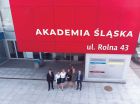
43 Rolna Street
40-555 Katowice
tel. 32 60 72 425
32 20 25 034
32 20 46 612
32 25 22 874
32 60 72 400
University
The founder of Katowice School of Technology is Arkadiusz Hołda. The school was founded following the decision of the Minister of National Education of 15th December, 2003 and entered in the register of private higher vocational schools (with the number 143). The aim of the school is to form a modern system of education for engineers whose qualifications meet European standards.

Katowice School of Technology is the first, private higher school in Silesia which offers Bachelor study programmes in the following specialisations:
  • Architecture
  • Interior Design
  • Civil Construction
  • Spatial Development
  • Design
  • Graphics
  • Directing
  • Journalism and Social Communication
Privacy Policy