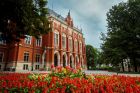
The faculty, established in 2017, consists of the Institute of Geography and Spatial Management and the Institute of Geological Sciences. It offers first- and second-cycle study programmes in Geography, Spatial E-Management, and Geology as well as PhD programmes.
Geography (from Greek γεωγραφία, geographia, literally "earth description") is a field of science devoted to the study of the lands, the features, the inhabitants, and the phenomena of Earth. The first person to use the word "γεωγραφία" was Eratosthenes (276–194 BC). Geography is an all-encompassing discipline that seeks an understanding of the Earth and its human and natural complexities—not merely where objects are, but how they have changed and come to be.
Geology (from the Ancient Greek γῆ, gē, i.e. "earth" and -λoγία, -logia, i.e. "study of, discourse") is an earth science concerned with the solid Earth, the rocks of which it is composed, and the processes by which they change over time. Geology can also refer to the study of the solid features of any terrestrial planet or natural satellite, (such as Mars or the Moon).
The past history of our globe must be explained by what can be seen to be happening now. No powers are to be employed that are not natural to the globe, no action to be admitted except those of which we know the principle.
James Hutton, Theory of the Earth. (Paper, published in Transactions of the Royal Society of Edinburgh in 1785).
The increasing number of factors playing a role in the various complexes of natural phenomena are the origin of new, so-called emergent, laws and characteristics. Based on this principle of emergence, a hierarchy of sciences can be distinguished: physics-chemistry-geology-biology-psychology.
Josiah Gilbert Holland, in Rev. S. Pollock Linn Golden Gleams of Thought from the Words of Leading Orators, Divines, Philosophers, Statesmen and Poets, A.C. McClurg & Company, 1881, p. 280.