Warsaw, Poland

Typhlopedagogy – Education and Rehabilitation of People with Visual Impairment

Tyflopedagogika – Edukacja i rehabilitacja osób z niepełnosprawnością wzrokową

Table of contents
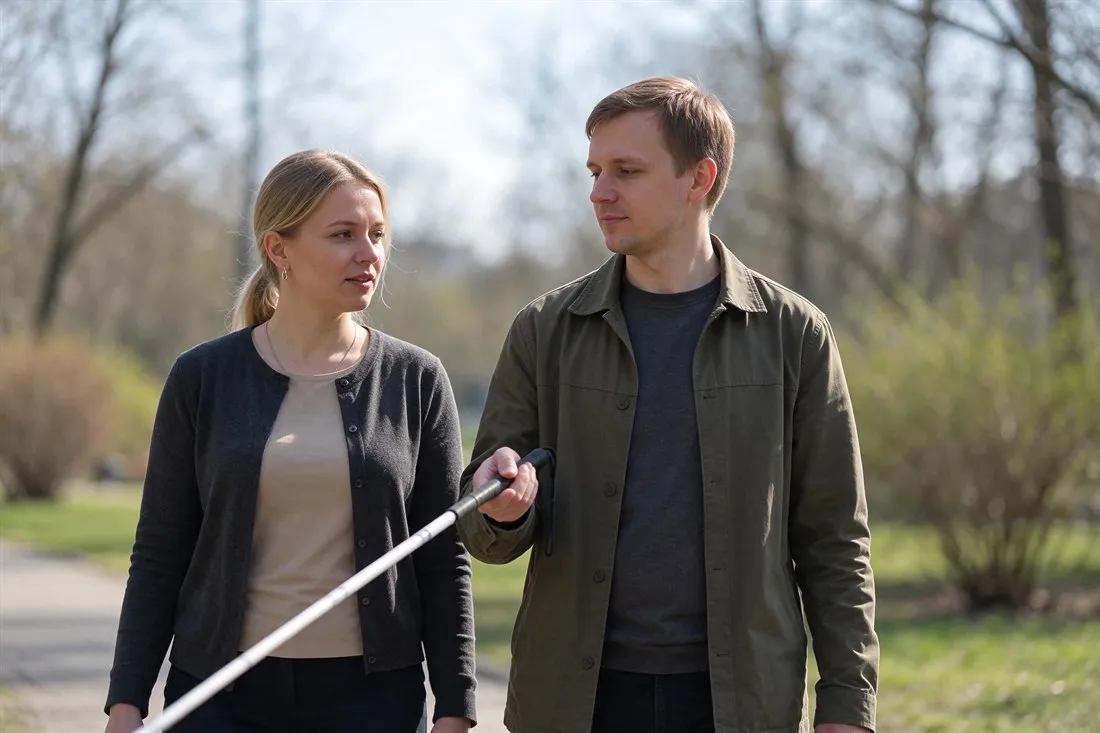
Instruktorka idzie parkową alejką z mężczyzną z białą laską

⇑Typhlopedagogy – Education and Rehabilitation of People with Visual Impairment at EUNMiS

Language: Polish Studies in Polish
Subject area: teacher training and education science
University website: eunmis.edu.pl

⇑Test: sprawdź czy Tyflopedagogika – Edukacja i rehabilitacja osób z niepełnosprawnością wzrokową to studia dla Ciebie

Instruktorka idzie parkową alejką z mężczyzną z białą laską

10 pytań · dwie minuty

1. Do poradni przychodzi dorosły mężczyzna, który niedawno stracił wzrok i przestał wychodzić z domu. Od czego zaczynasz pracę z nim?

2. Uczeń słabowidzący w klasie ogólnodostępnej nie nadąża z odczytywaniem tablicy. Co proponujesz nauczycielom?

3. Uczysz dorosłą osobę pisma punktowego i widzisz, że po kilku zajęciach traci zapał. Co robisz?

4. Rodzice niewidomego przedszkolaka wyręczają go we wszystkim, nawet przy jedzeniu. Jak z nimi rozmawiasz?

5. Przygotowujesz z osobą niewidomą trasę samodzielnego dojścia z domu do pracy. Na co zwracasz uwagę?

6. Muzeum planuje wystawę dostępną dla osób z niepełnosprawnością wzrokową i prosi Cię o radę. Co podpowiadasz?

7. Starsza pani, która przez chorobę oczu słabo widzi, przestaje gotować i czytać. Jak jej pomagasz?

8. Na zajęciach z orientacji uczeń z białą laską waha się przed wejściem na schody ruchome. Jak reagujesz?

9. Firma zatrudnia niewidomego księgowego i pyta, jak przygotować jego stanowisko pracy. Co doradzasz?

10. Co najbardziej motywuje Cię do podjęcia studiów podyplomowych „Tyflopedagogika – Edukacja i rehabilitacja osób z niepełnosprawnością wzrokową”?

⇑Definitions and quotes

Education
Education is the process of facilitating learning, or the acquisition of knowledge, skills, values, beliefs, and habits. Educational methods include storytelling, discussion, teaching, training, and directed research. Education frequently takes place under the guidance of educators, but learners may also educate themselves. Education can take place in formal or informal settings and any experience that has a formative effect on the way one thinks, feels, or acts may be considered educational. The methodology of teaching is called pedagogy.
People
A people is a plurality of persons considered as a whole, as is the case with an ethnic group or nation. Collectively, for example, the contemporary Frisians and Danes are two related Germanic peoples, while various Middle Eastern ethnic groups are often linguistically categorized as Semitic peoples.
Education
What we need is to justify coercion, paternalistic control, blame, scolding, and punishment - all of which are less evident in trigonometry class than in a fourth grade learning long division.(...) I have argued that blame, scolding, and punishment in public schools - what I have called "the ordeal" - can be successfully defended. Students have a duty to learn, and can be held responsible for violating whatever rules, policies, or instructions are enforced to ensure that they do so.
Charles Howell - Syracuse University: Education, Punishment, and Responsibility
Education
Give me a dozen healthy infants, well-formed, and my own specified world to bring them up in and I'll guarantee to take any one at random and train him to become any type of specialist I might select – doctor, lawyer, artist, merchant-chief and, yes, even beggar-man and thief, regardless of his talents, penchants, tendencies, abilities, vocations, and race of his ancestors. I am going beyond my facts and I admit it, but so have the advocates of the contrary and they have been doing it for many thousands of years.
John B. Watson. Behaviorism (Revised edition). (1930). Chicago: University of Chicago Press. p.82.
Education
We must encourage [each other] once we have grasped the basic points to interconnecting everything else on our own, to use memory to guide our original thinking, and to accept what someone else says as a starting point, a seed to be nourished and grown. For the correct analogy for the mind is not a vessel that needs filling but wood that needs igniting no more and then it motivates one towards originality and instills the desire for truth. Suppose someone were to go and ask his neighbors for fire and find a substantial blaze there, and just stay there continually warming himself: that is no different from someone who goes to someone else to get to some of his rationality, and fails to realize that he ought to ignite his own flame, his own intellect, but is happy to sit entranced by the lecture, and the words trigger only associative thinking and bring, as it were, only a flush to his cheeks and a glow to his limbs; but he has not dispelled or dispersed, in the warm light of philosophy, the internal dank gloom of his mind.
Plutarch, On Listening to Lectures.
StudentNews Group Websites for students and future students — in Poland since 2007, across Europe since 2014. Over 50 websites and millions of users a year (Google Analytics). Studies in Europe Universities in Europe Bachelor’s Master’s Doctorate MBA Study guide Work abroad Travel For partners Advertising and cooperation Reach (online report) Contact advertising@studentnews.eu © 2003–2026 Grupa StudentNews.pl sp. z o.o., Modlnica, Poland
Privacy Policy