Elbląg, Poland

English in Preschool Education and Early Childhood Education

Język angielski w wychowaniu przedszkolnym i edukacji wczesnoszkolnej

Table of contents
Postgraduate diplomas

English in Preschool Education and Early Childhood Education

⇑English in Preschool Education and Early Childhood Education at ANS Elbląg

Language: Polish Studies in Polish
Subject area: languages
University website: www.study.ans-elblag.pl

⇑Test: sprawdź czy Język angielski w wychowaniu przedszkolnym i edukacji wczesnoszkolnej to studia dla Ciebie

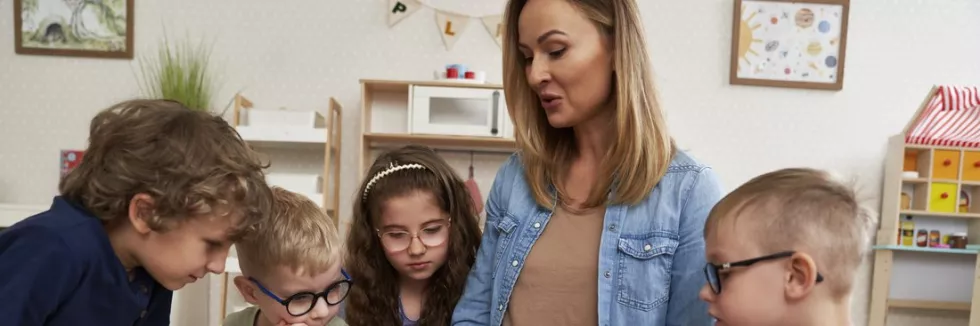
jezyk-angielski-w-wychowaniu-przedszkolnym-i-edukacji-wczesnoszkolnej-nauczycielka-czyta-ksiazke-z-dziecmi-na-

10 pytań · dwie minuty

1. Rano w przedszkolu dzieci schodzą się do sali. Jak możesz wpleść angielski w ten moment dnia?

2. Trzylatek nie chce śpiewać angielskiej piosenki razem z grupą i tylko się przygląda. Jak reagujesz?

3. Jak wykorzystujesz zabawę swobodną dzieci do osłuchiwania ich z angielskim?

4. Jak wygląda Twoim zdaniem dobra organizacja kącika językowego w sali przedszkolnej?

5. Dziecko w grupie przedszkolnej źle się czuje z rozłąką z rodzicem i płacze. Co w tej sytuacji jest najważniejsze?

6. Jak przygotowujesz zajęcia z angielskiego dla grupy, w której są dzieci w różnym wieku?

7. Dzieci kończą zerówkę i przechodzą do pierwszej klasy. Jak wspierasz tę zmianę w nauce angielskiego?

8. Rodzice na zebraniu dopytują, po co uczyć angielskiego tak małe dzieci. Co odpowiadasz?

9. Jakie formy pracy z najmłodszymi lubisz najbardziej?

10. Co najbardziej motywuje Cię do podjęcia studiów podyplomowych „Język angielski w wychowaniu przedszkolnym i edukacji wczesnoszkolnej”?

⇑Definitions and quotes

Childhood
Childhood is the age span ranging from birth to adolescence. According to Piaget's theory of cognitive development, childhood consists of two stages: preoperational stage and concrete operational stage. In developmental psychology, childhood is divided up into the developmental stages of toddlerhood (learning to walk), early childhood (play age), middle childhood (school age), and adolescence (puberty through post-puberty). Various childhood factors could affect a person's attitude formation.
Early Childhood
Early childhood is a stage in human development. It generally includes toddlerhood and some time afterwards. Play age is an unspecific designation approximately within the scope of early childhood. Some age-related development periods and examples of defined intervals are: newborn (ages 0–5 weeks); infant (ages 5 weeks – 1 year); toddler (ages 1–3 years); preschooler (ages 3–5 years); school-aged child (ages 6–11); adolescent (ages 12–17).
Education
Education is the process of facilitating learning, or the acquisition of knowledge, skills, values, beliefs, and habits. Educational methods include storytelling, discussion, teaching, training, and directed research. Education frequently takes place under the guidance of educators, but learners may also educate themselves. Education can take place in formal or informal settings and any experience that has a formative effect on the way one thinks, feels, or acts may be considered educational. The methodology of teaching is called pedagogy.
Education
What we need is to justify coercion, paternalistic control, blame, scolding, and punishment - all of which are less evident in trigonometry class than in a fourth grade learning long division.(...) I have argued that blame, scolding, and punishment in public schools - what I have called "the ordeal" - can be successfully defended. Students have a duty to learn, and can be held responsible for violating whatever rules, policies, or instructions are enforced to ensure that they do so.
Charles Howell - Syracuse University: Education, Punishment, and Responsibility
Education
Give me a dozen healthy infants, well-formed, and my own specified world to bring them up in and I'll guarantee to take any one at random and train him to become any type of specialist I might select – doctor, lawyer, artist, merchant-chief and, yes, even beggar-man and thief, regardless of his talents, penchants, tendencies, abilities, vocations, and race of his ancestors. I am going beyond my facts and I admit it, but so have the advocates of the contrary and they have been doing it for many thousands of years.
John B. Watson. Behaviorism (Revised edition). (1930). Chicago: University of Chicago Press. p.82.
Childhood
Happy is the man that hath his quiver full of them.
Psalms. CXXVII. 5.
StudentNews Group Websites for students and future students — in Poland since 2007, across Europe since 2014. Over 50 websites and millions of users a year (Google Analytics). Studies in Europe Universities in Europe Bachelor’s Master’s Doctorate MBA Study guide Work abroad Travel For partners Advertising and cooperation Reach (online report) Contact advertising@studentnews.eu © 2003–2026 Grupa StudentNews.pl sp. z o.o., Modlnica, Poland
Privacy Policy