Toruń, Poland

Generative AI in Marketing. Generative Artificial Intelligence in Marketing and Communication

Generative AI in marketing. Generatywna sztuczna inteligencja w marketingu i komunikacji

Table of contents
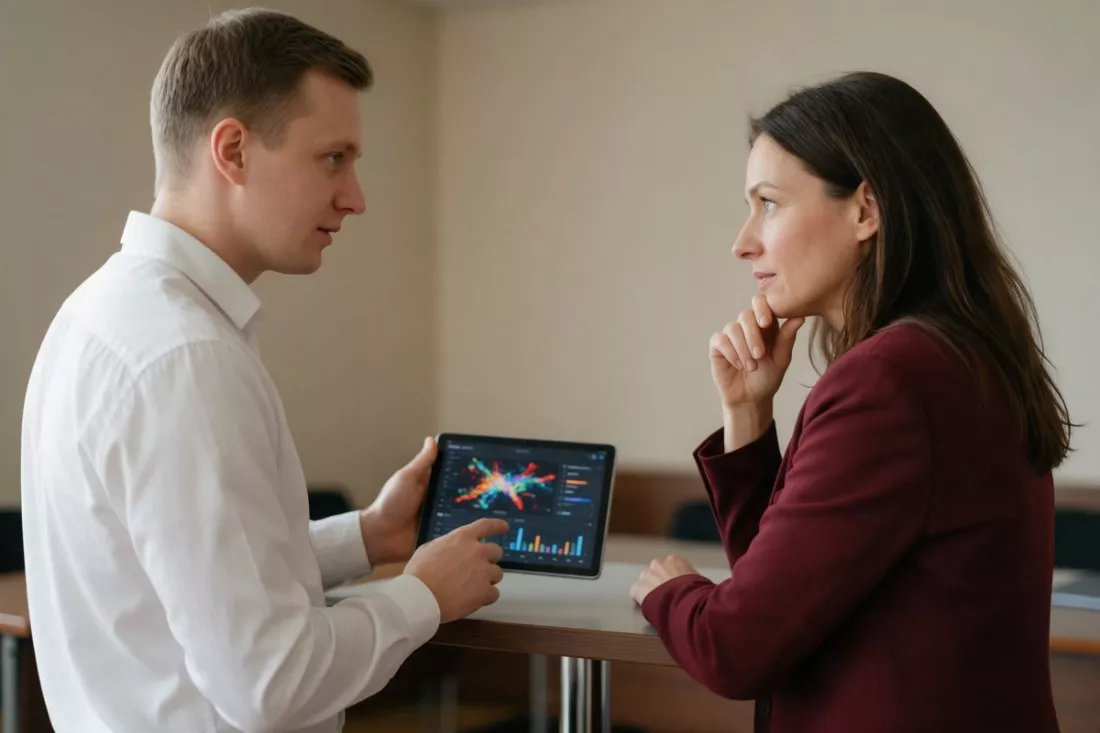
specjalista pokazuje kampanię menedżerce marketingu

⇑Generative AI in Marketing. Generative Artificial Intelligence in Marketing and Communication at Merito Toruń

Language: Polish Studies in Polish
Subject area: economy and administration
University website: www.merito.pl/english/torun

⇑Test: sprawdź czy Generative AI in Marketing. Generatywna Sztuczna Inteligencja w marketingu i komunikacji to studia dla Ciebie

marketerka i marketer pracują z AI

10 pytań · dwie minuty

1. Szef prosi o koncepcję kampanii nowego produktu w ciągu tygodnia. Jak wykorzystujesz narzędzia generatywnej AI?

2. Teksty z AI są poprawne, ale nijakie i nie przypominają głosu marki. Co robisz?

3. Klient pyta, czy materiały stworzone z pomocą AI można bezpiecznie publikować. Co odpowiadasz?

4. Chcesz przygotować spersonalizowane wiadomości dla kilku grup klientów. Jak to robisz?

5. Czy lubisz eksperymentować z poleceniami dla AI i sprawdzać, jak zmiana kilku słów wpływa na wynik?

6. Narzędzie AI dopisało w poście „fakty” o produkcie, których nie ma w jego specyfikacji. Jak reagujesz?

7. Dział komunikacji wewnętrznej pyta, jak AI może pomóc w jego pracy. Co proponujesz?

8. Jak oceniasz, czy kampania przygotowana z pomocą AI przyniosła efekty?

9. Firma przechodzi kryzys wizerunkowy i ktoś proponuje, by oświadczenie w całości napisała AI. Co o tym myślisz?

10. Co najbardziej motywuje Cię do podjęcia studiów podyplomowych „Generative AI in Marketing. Generatywna Sztuczna Inteligencja w marketingu i komunikacji”?

⇑Definitions and quotes

Artificial Intelligence
Artificial intelligence (AI, also machine intelligence, MI) is intelligence demonstrated by machines, in contrast to the natural intelligence (NI) displayed by humans and other animals. In computer science AI research is defined as the study of "intelligent agents": any device that perceives its environment and takes actions that maximize its chance of successfully achieving its goals. Colloquially, the term "artificial intelligence" is applied when a machine mimics "cognitive" functions that humans associate with other human minds, such as "learning" and "problem solving".
Communication
Communication (from Latin commūnicāre, meaning "to share") is the act of conveying intended meanings from one entity or group to another through the use of mutually understood signs and semiotic rules.
Intelligence
Intelligence has been defined in many different ways to include the capacity for logic, understanding, self-awareness, learning, emotional knowledge, reasoning, planning, creativity, and problem solving. It can be more generally described as the ability to perceive or infer information, and to retain it as knowledge to be applied towards adaptive behaviors within an environment or context.
Marketing
Marketing is the study and management of exchange relationships. Marketing is used to create, keep and satisfy the customer. With the customer as the focus of its activities, it can be concluded that Marketing is one of the premier components of Business Management - the other being innovation.
Artificial Intelligence
I have grown accustomed to the disrespect expressed by some of the participants for their colleagues in the other disciplines. "Why, Dan," ask the people in artificial intelligence, "do you waste your time conferring with those neuroscientists? They wave their hands about 'information processing' and worry about where it happens, and which neurotransmitters are involved, but they haven't a clue about the computational requirements of higher cognitive functions." "Why," ask the neuroscientists, "do you waste your time on the fantasies of artificial intelligence? They just invent whatever machinery they want, and say unpardonably ignorant things about the brain." The cognitive psychologists, meanwhile, are accused of concocting models with neither biological plausibility nor proven computational powers; the anthropologists wouldn't know a model if they saw one, and the philosophers, as we all know, just take in each other's laundry, warning about confusions they themselves have created, in an arena bereft of both data and empirically testable theories. With so many idiots working on the problem, no wonder consciousness is still a mystery. All these charges are true, and more besides, but I have yet to encounter any idiots. Mostly the theorists I have drawn from strike me as very smart people – even brilliant people, with the arrogance and impatience that often comes with brilliance – but with limited perspectives and agendas, trying to make progress on the hard problems by taking whatever shortcuts they can see, while deploring other people's shortcuts. No one can keep all the problems and details clear, including me, and everyone has to mumble, guess and handwave about large parts of the problem.
Daniel Dennett (1991) Consciousness Explained
Artificial Intelligence
We define a semantic network as "the collection of all the relationships that concepts have to other concepts, to percepts, to procedures, and to motor mechanisms" of the knowledge".
John F. Sowa (1984) Conceptual Structures. p. 76
Intelligence
The desire of appearing clever often prevents our becoming so.
François de La Rochefoucauld, Maxims (1665–1678), Maxim 199.

Contact:

ul. Młodzieżowa 31A
87 – 100 Toruń
StudentNews Group Websites for students and future students — in Poland since 2007, across Europe since 2014. Over 50 websites and millions of users a year (Google Analytics). Studies in Europe Universities in Europe Bachelor’s Master’s Doctorate MBA Study guide Work abroad Travel For partners Advertising and cooperation Reach (online report) Contact advertising@studentnews.eu © 2003–2026 Grupa StudentNews.pl sp. z o.o., Modlnica, Poland
Privacy Policy