
Częstochowa, Poland

Drug Chemistry
(field of studies: Chemistry)

Chemia leków

Bachelor's
Table of contents
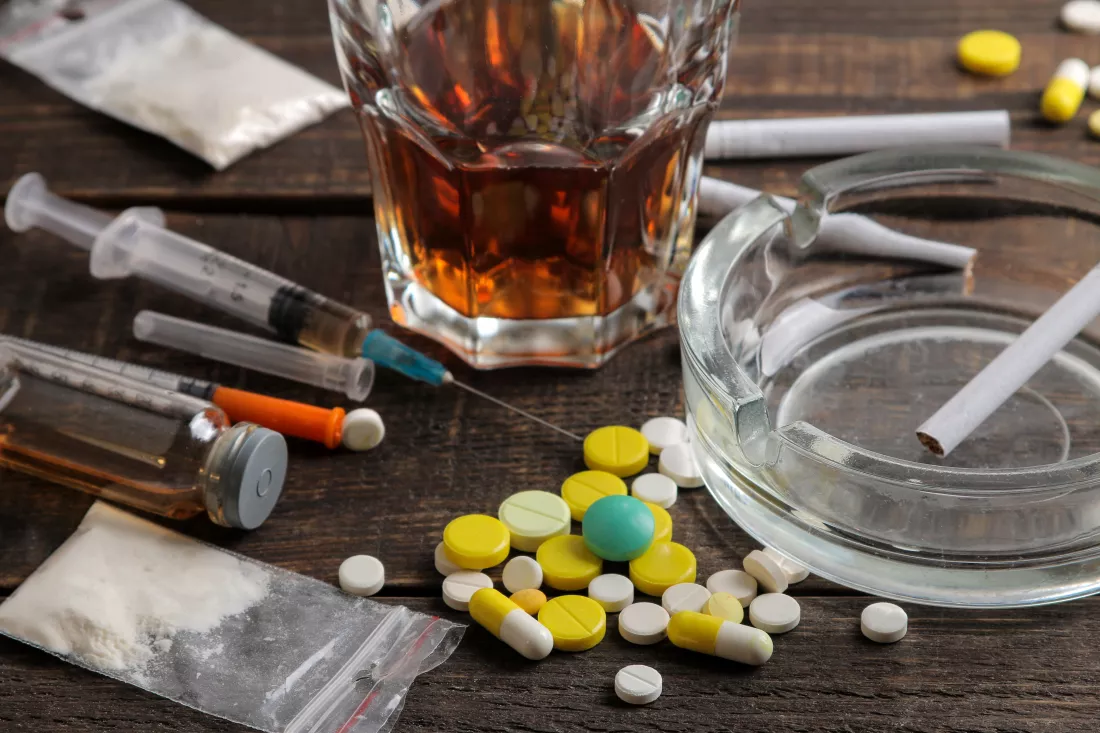
various-addictive-drugs-including-alcohol-cigarettes-drugs-brown-wooden-table-drug-addiction-concept

⇑Drug Chemistry at UJD

Field of studies: Chemistry
Language: PolishStudies in Polish
Subject area: physical science, environment
Kind of studies: full-time studies, part-time studies
  • Description:

  • pl
University website: www.en.ujd.edu.pl

⇑Why choose the Drug Chemistry specialisation at UJD?

Dlaczego warto studiować na UJD
Why study it:

Drug Chemistry is a specialisation in the Chemistry programme (first-degree studies, taught in English) at Jan Długosz University in Częstochowa. It is meant for people curious about how medicines are designed, made and tested.

Specialisation: from drug design to synthesis

The specialisation adds extended knowledge of methods used in the synthesis and analysis of drugs, with courses such as:

  • structural aspects in drug design – designing drugs in silico, pharmacophores, SAR and QSAR, drug-receptor interactions,
  • advanced organic synthesis in drug chemistry – total syntheses of marketed drugs together with their reaction mechanisms,
  • chemical methods of obtaining medicinal substances – natural and synthetic ones,
  • spectroscopic methods in drug analysis – infrared, UV-VIS and NMR spectroscopy and mass spectrometry,
  • engineering of biomaterials – metallic, ceramic and polymeric biomaterials, controlled drug release and artificial organs.

Labs: laboratories with real medicines

In the laboratory of drug analysis you examine known drugs: alkaloids, vitamins, antibiotics, barbiturates and sulfonamides, and you use thin-layer chromatography as a pharmacopoeial way to confirm the identity of an active substance.

Drug form technology is a laboratory course too. You test the uniformity of active substance content in tablets, capsules and suppositories, check how the substance is released from solid forms and examine solids by X-ray powder diffraction. In the course on obtaining medicinal substances you isolate selected plant alkaloids and carry out syntheses of sulfaguanidine and of a nicotinic acid derivative.

After graduation: where the track leads

After the specialisation

  • Optional moduleMedical Chemistry – human anatomy and physiology, pharmacology and pharmacognosy, modern synthesis of drugs and drug patenting
  • Workplaceschemical, cosmetic and pharmacological laboratories, industrial and research
  • Industriespharmaceutical and biotechnology
  • Next stepsecond-degree studies in Chemistry

Based on the study plan and the UJD admissions page.

Updated: 11.11.2026
⇑Test: Is Drug Chemistry the right fit for you?

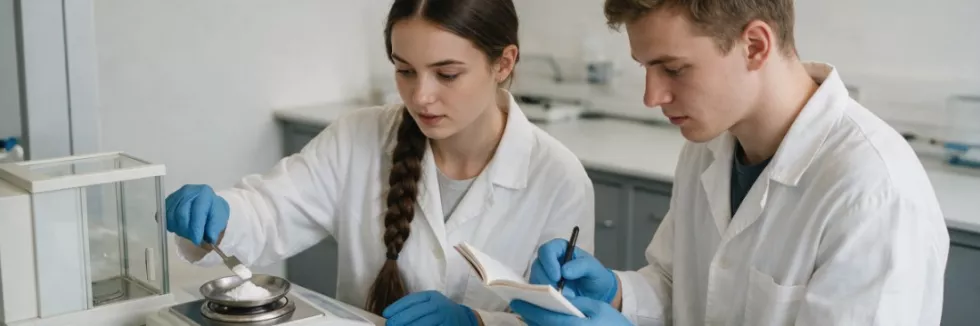
chemistry-students-weighing-a-drug-substance-in-a-lab

10 questions · two minutes

1. How do you feel about organic chemistry – functional groups, reactions and mechanisms?

2. In a lab class you’re asked to make a simple compound such as aspirin and purify it. How does that sound?

3. Have you ever wondered how a painkiller knows where to act in the body?

4. Working with flammable solvents and toxic reagents requires strict safety rules. How do you feel about that?

5. Your sample might contain an impurity. How would you check?

6. How do you feel about calculating concentrations, yields and molar masses?

7. The programme is taught in English, and you’ll work in the lab with students from many countries. How do you see that?

8. A synthesis gives a much lower yield than expected. What do you do?

9. Which future job sounds most like you?

10. What motivates you most to study Drug Chemistry?

⇑Definitions and quotes

Chemistry
Chemistry is the scientific discipline involved with compounds composed of atoms, i.e. elements, and molecules, i.e. combinations of atoms: their composition, structure, properties, behavior and the changes they undergo during a reaction with other compounds. Chemistry addresses topics such as how atoms and molecules interact via chemical bonds to form new chemical compounds. There are four types of chemical bonds: covalent bonds, in which compounds share one or more electron(s); ionic bonds, in which a compound donates one or more electrons to another compound to produce ions (cations and anions); hydrogen bonds; and Van der Waals force bonds.
Drug
A drug is any substance (other than food that provides nutritional support) that, when inhaled, injected, smoked, consumed, absorbed via a patch on the skin, or dissolved under the tongue causes a temporary physiological (and often psychological) change in the body.
Chemistry
Like literature, philosophy is not distinguished from other subjects by a specific approach to a subject-matter independent of it. Chemistry deals with chemicals, biology with life and astronomy with very large, very distant objects. Philosophy can boast no such definite subject-matter.
David Wood (philosopher) (1990) Philosophy At The Limit. p. 69
Chemistry
The alchemical tradition assumes that every physical art or science is a body of knowledge which exists only because it is ensouled by invisible powers and processes. Physical chemistry, as it is practiced in the modern world, is concerned principally with pharmaceutical or industrial research projects. It is confined within the boundaries of an all-pervading materialism, which binds labor to the advancement of physical objectives.
Manly Palmer Hall (1988) Meditation Symbols in Eastern & Western Mysticism
Chemistry
Modern warfare, we discovered, was to a far greater extent than ever before a conflict of chemists and manufacturers. Manpower, it is true, was indispensable, and generalship will always, whatever the conditions, have a vital part to play. But troops, however brave and well led, were powerless under modern conditions unless equipped with adequate and up-to-date artillery (with masses of explosive shell), machine-guns, aircraft and other supplies. Against enemy machine-gun posts and wire entanglements the most gallant and best-led men could only throw away their precious lives in successive waves of heroic martyrdom. Their costly sacrifice could avail nothing for the winning of victory.
David Lloyd George (1938) War Memoirs

Contact:

Waszyngtona str. 4/8
42-200 Częstochowa
phone +48 34 378 41 00
StudentNews Group Websites for students and future students — in Poland since 2007, across Europe since 2014. Over 50 websites and millions of users a year (Google Analytics). Studies in Europe Universities in Europe Bachelor’s Master’s Doctorate MBA Study guide Work abroad Travel For partners Advertising and cooperation Reach (online report) Contact advertising@studentnews.eu © 2003–2026 Grupa StudentNews.pl sp. z o.o., Modlnica, Poland
Privacy Policy