Warsaw, Poland

Artificial Intelligence and Machine Learning
(Computer Science)

Sztuczna inteligencja i uczenie maszynowe

Bachelor's
Table of contents
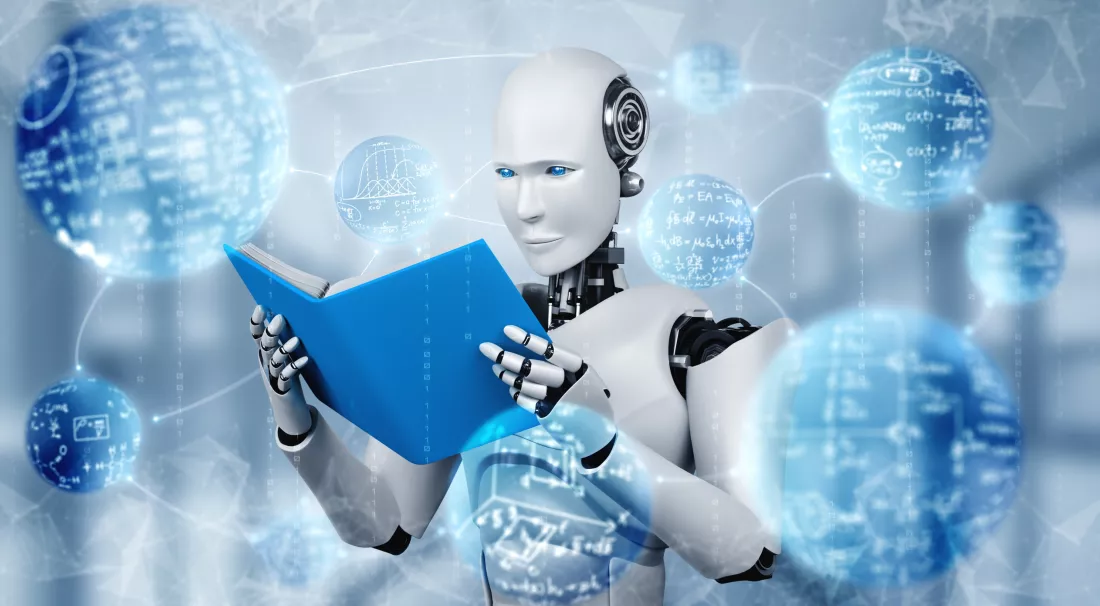
3d-illustration-robot-humanoid-reading-book(1)

Artificial Intelligence and Machine Learning at SWPS

Field of studies: Computer Science
Language: PolishStudies in Polish
Kind of studies: full-time studies
  • Description:

  • pl
University website: english.swps.pl

Definitions and quotes

Artificial Intelligence
Artificial intelligence (AI, also machine intelligence, MI) is intelligence demonstrated by machines, in contrast to the natural intelligence (NI) displayed by humans and other animals. In computer science AI research is defined as the study of "intelligent agents": any device that perceives its environment and takes actions that maximize its chance of successfully achieving its goals. Colloquially, the term "artificial intelligence" is applied when a machine mimics "cognitive" functions that humans associate with other human minds, such as "learning" and "problem solving".
Intelligence
Intelligence has been defined in many different ways to include the capacity for logic, understanding, self-awareness, learning, emotional knowledge, reasoning, planning, creativity, and problem solving. It can be more generally described as the ability to perceive or infer information, and to retain it as knowledge to be applied towards adaptive behaviors within an environment or context.
Machine
A machine uses power to apply forces and control movement to perform an intended action. Machines can be driven by animals and people, by natural forces such as wind and water, and by chemical, thermal, or electrical power, and include a system of mechanisms that shape the actuator input to achieve a specific application of output forces and movement. They can also include computers and sensors that monitor performance and plan movement, often called mechanical systems.
Machine Learning
Machine learning is a field of computer science that often uses statistical techniques to give computers the ability to "learn" (i.e., progressively improve performance on a specific task) with data, without being explicitly programmed.
Machine
Ere many generations pass, our machinery will be driven by a power obtainable at any point of the universe. This idea is not novel. Men have been led to it long ago by instinct or reason; it has been expressed in many ways, and in many places, in the history of old and new. We find it in the delightful myth of Antheus, who derives power from the earth; we find it among the subtle speculations of one of your splendid mathematicians and in many hints and statements of thinkers of the present time. Throughout space there is energy. Is this energy static or kinetic! If static our hopes are in vain; if kinetic — and this we know it is, for certain — then it is a mere question of time when men will succeed in attaching their machinery to the very wheelwork of nature.
Nikola Tesla "Experiments With Alternate Currents Of High Potential And High Frequency" (February 1892)
Artificial Intelligence
I have grown accustomed to the disrespect expressed by some of the participants for their colleagues in the other disciplines. "Why, Dan," ask the people in artificial intelligence, "do you waste your time conferring with those neuroscientists? They wave their hands about 'information processing' and worry about where it happens, and which neurotransmitters are involved, but they haven't a clue about the computational requirements of higher cognitive functions." "Why," ask the neuroscientists, "do you waste your time on the fantasies of artificial intelligence? They just invent whatever machinery they want, and say unpardonably ignorant things about the brain." The cognitive psychologists, meanwhile, are accused of concocting models with neither biological plausibility nor proven computational powers; the anthropologists wouldn't know a model if they saw one, and the philosophers, as we all know, just take in each other's laundry, warning about confusions they themselves have created, in an arena bereft of both data and empirically testable theories. With so many idiots working on the problem, no wonder consciousness is still a mystery. All these charges are true, and more besides, but I have yet to encounter any idiots. Mostly the theorists I have drawn from strike me as very smart people – even brilliant people, with the arrogance and impatience that often comes with brilliance – but with limited perspectives and agendas, trying to make progress on the hard problems by taking whatever shortcuts they can see, while deploring other people's shortcuts. No one can keep all the problems and details clear, including me, and everyone has to mumble, guess and handwave about large parts of the problem.
Daniel Dennett (1991) Consciousness Explained

Artificial Intelligence
We define a semantic network as "the collection of all the relationships that concepts have to other concepts, to percepts, to procedures, and to motor mechanisms" of the knowledge".
John F. Sowa (1984) Conceptual Structures. p. 76

Contact:

Chodakowska 19/31 str.
03-815 Warszawa
tel. + 48 22 103 26 30
Privacy Policy